Why would an AI agent choose your company? →
Current answer · Explainer
Understanding how a company enters the comparison helps locate the stage a GEO intervention is intended to change.
Some GEO changes improve visibility in specific systems. Evidence for a repeatable route from a page edit to profitable demand is much thinner. Find where your offer is being lost, address the cause and measure the customer outcome you care about.
Tested workflow · see the test’s scope
Following covers this question’s published contributions. It does not follow neighbouring questions or subscribe you to email.
What the evidence says about being found, recommended and chosen by AI.
Published experiments, observational data and platform guidance. No universal ranking formula or demonstrated Atlas GEO return.
Article version history → Does GEO actually work?A practical Codex comparison: the same facts in different formats, then new information. Includes the files, recorded answers and checks.
Tested on fictional offers supplied directly to Codex. No search visibility or sales measured.
Article version history → Test whether AI understands your offerThese narrower questions are not promises of a future article.
Independent, repeated interventions with suitable controls, exposed retrieval where possible, accuracy checks and downstream outcomes. Atlas has completed a constructed reading comparison; naturally difficult, unseen cases and public discovery remain to be tested.
See the limits of this answer →Held-out customer cases, new model configurations and separate retrieval observations; commercial value requires its own downstream comparison.
See the limits of this answer →Question versions describe its framing, published contributions and place in the map. Article versions keep their own evidence and history.
Adds a tested reading-stage Playbook: no formatting difference observed in a ceiling fixture; two added facts resolve decisions in opposite directions. Public discovery and commercial effects remain open. The Explainer status is updated to point to the completed test; its earlier research remains unchanged.
See this change across Atlas →A new answer examines which GEO interventions are supported by research and separates visibility from commercial outcomes.
See this change across Atlas →Original article history and evidence
This history comes from saved content versions. A new revision can be an editorial change; it does not by itself mean that the underlying facts changed.
The proposed reading-stage comparison is now executed and published in a companion Playbook. Its ceiling result adds no evidence of a formatting gain or commercial GEO return; prior research and figures remain unchanged.
Start with a customer need, locate where useful information is lost and choose a comparison that could disprove the proposed remedy. Our next investigation will test the reading stage before claiming anything about discovery or revenue.
Start with a customer need, locate where useful information is lost and choose a comparison that could disprove the proposed remedy. Our companion Playbook now records the reading-stage comparison. Public discovery and commercial return still require separate tests.
Independent, repeated interventions with suitable controls, exposed retrieval where possible, accuracy checks and downstream outcomes. The next Atlas reading comparison is proposed, not executed.
Independent, repeated interventions with suitable controls, exposed retrieval where possible, accuracy checks and downstream outcomes. Atlas has completed a constructed reading comparison; naturally difficult, unseen cases and public discovery remain to be tested.
Our proposed Atlas comparison separates clearer presentation from new information. It compares original prose, the same facts reorganized, and a version with previously omitted but verified facts. The test should include cases where the competitor fits better, delivery is unknown or the original already works. Success means a better-supported customer decision. Repetition, varied product order and fresh questions help distinguish a useful change from a lucky answer. This controlled reading test can examine what happens after information reaches the model. Discoverability needs a separate live-service study; incremental sales need a further commercial comparison. The protocol is prepared but has not been executed. Until that evidence exists, we recommend a limited investigation with clear criteria for continuing, revising or stopping. Ask which part of the customer’s decision a proposed GEO investment will change, and what observation would show that it failed.
Atlas has now run the supplied-information part of this comparison. The companion Playbook, “Test whether AI understands your offer”, contains the working files, recorded answers and checks. It compares prose, the same facts in labelled bullets, and a third version with two newly disclosed facts from a fictional offer record. Each condition produced 24 of 24 correct answers in these authored cases. The prose baseline already passed every check, so the comparison could not demonstrate an accuracy improvement. With the two added facts, eight more answers reached a decision, including four that correctly rejected all offers. Counting only recommendations for your brand would miss that distinction. This is a first reading-stage test. More difficult, unseen customer questions are needed before generalizing. Public discovery requires a separate live-service study; incremental sales need a further commercial comparison. Ask which part of the customer’s decision a proposed GEO investment will change, and what observation would show that it failed.
Not present in this version.
Same facts, new facts: the Atlas offer-reading comparison
Not present in this version.
Prose, labelled bullets and bullets with added facts each produced 24/24 correct answers. With the added facts, eight more answers reached a decision, including four correct rejections.
Not present in this version.
A constructed six-case comparison repeated in twelve sessions with one requested model configuration. No search, customers or sales measured. The Playbook preserves the protocol, outputs and evaluator correction.
Not present in this version.
Same facts, new facts: the Atlas offer-reading comparison · Protocol v1 · 12 sessions, 72 answers · evaluator erratum disclosed · Protocol v1; 72 answers checked by a separate Atlas AI reviewer; disclosed evaluator erratum · https://www.thelivingatlas.io/explore/test-ai-product-recommendations/kit/record/TEST.md
The proposed reading-stage comparison is now executed and published in a companion Playbook. Its ceiling result adds no evidence of a formatting gain or commercial GEO return; prior research and figures remain unchanged.
Start with a customer need, locate where useful information is lost and choose a comparison that could disprove the proposed remedy. Our companion Playbook now records the reading-stage comparison. Public discovery and commercial return still require separate tests.
Independent, repeated interventions with suitable controls, exposed retrieval where possible, accuracy checks and downstream outcomes. Atlas has completed a constructed reading comparison; naturally difficult, unseen cases and public discovery remain to be tested.
Some GEO changes improve visibility in specific systems. Evidence for a repeatable route from a page edit to profitable demand is much thinner. Find where your offer is being lost, address the cause and measure the customer outcome you care about.
Published experiments, observational data and platform guidance. No universal ranking formula or demonstrated Atlas GEO return.
GEO reported improvements in answer-visibility measures; its main setup optimized a source already supplied to the generator. That result does not establish additional sales.
Historical experimental setup and metric, not a forecast for current services.
C-SEO Bench finds limited, model- and domain-dependent gains from tested rewrites. Moving a document within the supplied context has a larger effect in its comparison.
Context order was manipulated directly. No real-world SEO intervention or customer purchase was tested.
SAGEO Arena reindexes edited documents and evaluates retrieval, reranking and answer citations separately. Its StageAware method improves some reported rates while reducing another.
Constructed pipeline; selected initial top-ten targets; reported table values without confidence intervals.
In two query sets, the Chen–Koudas preprint finds apparent citation benefits for several common page features across websites that do not persist within websites.
Observational page comparison, English US-market questions, API configurations and an October 2026 preprint. It does not show that those features never help.
The Marketing Science study reports ChatGPT conversion and revenue per session above paid social but below the other compared channels in its main analysis.
Historical, observational e-commerce data. The study does not randomize GEO changes or measure all AI-influenced purchases.
Google documents existing SEO fundamentals as relevant to its AI search features and says no additional technical requirements or special schema are needed.
One platform’s documentation; eligibility is not guaranteed inclusion or commercial effectiveness.
Prose, labelled bullets and bullets with added facts each produced 24/24 correct answers. With the added facts, eight more answers reached a decision, including four correct rejections.
A constructed six-case comparison repeated in twelve sessions with one requested model configuration. No search, customers or sales measured. The Playbook preserves the protocol, outputs and evaluator correction.
GEO, short for generative engine optimization, covers efforts to improve how a business or its information appears in AI-generated answers. For a company deciding where to invest, the useful starting point is the customer decision it wants to influence.
A source citation, a brand mention and a product recommendation answer different questions. They can also travel separately: another website can recommend your product, while your own guide supplies background for a competitor’s recommendation. A single visibility score can conceal that difference.
A shopper needs a desk no wider than 100 cm, delivered by Friday. Fictional Company A sells a 98 cm desk; its delivery date is unverified. Inspect four possible outcomes.
The answer links to Company A’s guide to small desks, then recommends another seller.
Check next Read the claim beside the link. Is the citation supporting the company’s offer or only background information?
Authored examples, not observed AI answers. These outcomes can overlap or occur through different channels; they are not a measured funnel.
The answer links to Company A’s guide to small desks, then recommends another seller.
Check next Read the claim beside the link. Is the citation supporting the company’s offer or only background information?
“Company A and Company B both offer compact desks.”
Check next Separate a name appearing from a supported, customer-relevant recommendation.
“Company A’s 98 cm desk fits your space. Confirm Friday delivery before ordering.”
Check next Check unresolved conditions and whether customers actually act on the recommendation.
The customer buys Company A’s desk through a retailer.
Check next Compare incremental contribution after costs and displaced sales, not only attributed revenue.
Pranjal Aggarwal and colleagues’ original GEO study gave a generator five sources and rewrote one of them. Its strongest headline concerned how much, and how prominently, the answer represented that source. That is a useful experiment on answer construction. It leaves open whether an edited page gets discovered in a changing web index or earns a customer.
The later C-SEO Bench, by Haritz Puerto and colleagues, asked about citation order across different tasks and models. Most tested rewrites did not reliably improve it. This is not a clean contradiction: taking more space in an answer and being cited earlier are different outcomes. Its stronger “SEO” baseline moved documents within the supplied context; it did not demonstrate the return from an SEO campaign.
41%
Approximate relative increase in position-adjusted answer visibility for quotation addition.
The reported score rises from 19.3 to 27.2. This is not a customer conversion rate.
A result can be real while answering a narrower question than the investment proposal.
Main Table 1, rounded scores. (27.2 ÷ 19.3 − 1) ×100 = 40.93%, displayed as 41%. Fixed five-source context. No customer revenue measured.
| Measure | Value |
|---|---|
| Approximate relative increase in position-adjusted answer visibility for quotation addition. | 41% |
Sunghwan Kim and colleagues built SAGEO Arena to put the missing search stages back into the experiment. An edited page returns to an index. It must then be retrieved and pass through another ranking stage before it can contribute to the answer.
Their StageAware approach changes structural fields and body text for those different jobs. The results below show why the stages need separate checks. Better visibility at the beginning does not imply that every intermediate step improves, and the final citation rate still says nothing about purchases.
A familiar brand may already have more coverage, links and relevant pages. If those pages also have FAQs, an across-site comparison can credit the FAQ with an advantage it did not create.
An October 2026 preprint by Mahe Chen and Nick Koudas illustrates the problem. Across 158,099 answers in two markets, collected through an academic monitoring platform the authors operate, several common page features appeared helpful across websites but not when comparing pages within the same website. Matching the question remained more informative. The authors also found that brand names could change rankings when supplied product facts stayed fixed.
The questions were in English and concerned the US market, and the answers came through selected API configurations. This is not a global consumer sample. The observational results do not prove that formatting is useless. The practical lesson is to demonstrate the effect of the change itself, rather than copying the features of an already successful competitor.
Suppose more people arrive from an AI assistant after you improve a product page. They may already have intended to buy. A model update, a seasonal change or new independent coverage could also have contributed. Referral analytics describe a route; they do not establish the additional business caused by your edit.
Maximilian Kaiser and Christian Schulze studied 973 e-commerce websites. In their main February–August 2025 analysis, ChatGPT referrals had higher conversion and revenue per session than paid social, but lower than the other compared channels. The sample spans continents and is concentrated in the Americas and Europe. These are historical observations, not a verdict on today’s AI traffic or on a GEO programme.
For Company A, an AI-assisted sale through a retailer might still be valuable. The decision depends on margin after costs, repeat business and which sale it replaces. Measuring only visits to the brand’s own site would miss part of the outcome; counting every referred order as new demand would overstate it.
Google says the existing SEO foundations remain relevant to AI Overviews and AI Mode, with no special AI file or schema required. Accessible, useful pages and accurate product information are sensible foundations. Eligibility alone does not tell you which additional investment is worthwhile.
Our recommendation is to follow a small set of real customer decisions over time, recording the offer, market, language, competing alternatives and evidence needed to choose. Inspect the answers and available source records. A missing citation alone cannot tell you whether a page was never retrieved or was read and omitted.
These are diagnostic recommendations, not interventions Atlas has shown to improve revenue.
Atlas has now run the supplied-information part of this comparison. The companion Playbook, “Test whether AI understands your offer”, contains the working files, recorded answers and checks. It compares prose, the same facts in labelled bullets, and a third version with two newly disclosed facts from a fictional offer record.
Each condition produced 24 of 24 correct answers in these authored cases. The prose baseline already passed every check, so the comparison could not demonstrate an accuracy improvement. With the two added facts, eight more answers reached a decision, including four that correctly rejected all offers. Counting only recommendations for your brand would miss that distinction.
This is a first reading-stage test. More difficult, unseen customer questions are needed before generalizing. Public discovery requires a separate live-service study; incremental sales need a further commercial comparison. Ask which part of the customer’s decision a proposed GEO investment will change, and what observation would show that it failed.
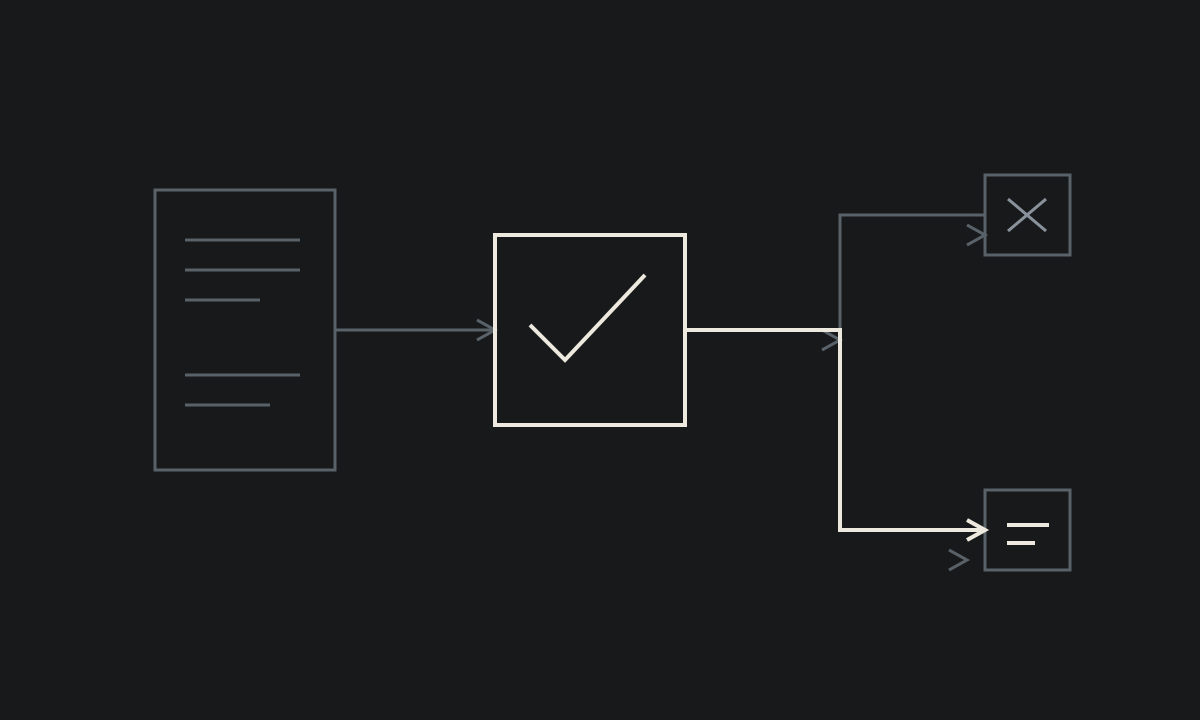
An answer can use your information without delivering the business outcome you intended. Conceptual illustration, not measured data.
Examines what GEO research measures and how companies can connect an intervention to the customer outcome they intend to change.
Start with a customer need, locate where useful information is lost and choose a comparison that could disprove the proposed remedy. Our next investigation will test the reading stage before claiming anything about discovery or revenue.
Independent, repeated interventions with suitable controls, exposed retrieval where possible, accuracy checks and downstream outcomes. The next Atlas reading comparison is proposed, not executed.
Some GEO changes improve visibility in specific systems. Evidence for a repeatable route from a page edit to profitable demand is much thinner. Find where your offer is being lost, address the cause and measure the customer outcome you care about.
Published experiments, observational data and platform guidance. No universal ranking formula or demonstrated Atlas GEO return.
GEO reported improvements in answer-visibility measures; its main setup optimized a source already supplied to the generator. That result does not establish additional sales.
Historical experimental setup and metric, not a forecast for current services.
C-SEO Bench finds limited, model- and domain-dependent gains from tested rewrites. Moving a document within the supplied context has a larger effect in its comparison.
Context order was manipulated directly. No real-world SEO intervention or customer purchase was tested.
SAGEO Arena reindexes edited documents and evaluates retrieval, reranking and answer citations separately. Its StageAware method improves some reported rates while reducing another.
Constructed pipeline; selected initial top-ten targets; reported table values without confidence intervals.
In two query sets, the Chen–Koudas preprint finds apparent citation benefits for several common page features across websites that do not persist within websites.
Observational page comparison, English US-market questions, API configurations and an October 2026 preprint. It does not show that those features never help.
The Marketing Science study reports ChatGPT conversion and revenue per session above paid social but below the other compared channels in its main analysis.
Historical, observational e-commerce data. The study does not randomize GEO changes or measure all AI-influenced purchases.
Google documents existing SEO fundamentals as relevant to its AI search features and says no additional technical requirements or special schema are needed.
One platform’s documentation; eligibility is not guaranteed inclusion or commercial effectiveness.
GEO, short for generative engine optimization, covers efforts to improve how a business or its information appears in AI-generated answers. For a company deciding where to invest, the useful starting point is the customer decision it wants to influence.
A source citation, a brand mention and a product recommendation answer different questions. They can also travel separately: another website can recommend your product, while your own guide supplies background for a competitor’s recommendation. A single visibility score can conceal that difference.
A shopper needs a desk no wider than 100 cm, delivered by Friday. Fictional Company A sells a 98 cm desk; its delivery date is unverified. Inspect four possible outcomes.
The answer links to Company A’s guide to small desks, then recommends another seller.
Check next Read the claim beside the link. Is the citation supporting the company’s offer or only background information?
Authored examples, not observed AI answers. These outcomes can overlap or occur through different channels; they are not a measured funnel.
The answer links to Company A’s guide to small desks, then recommends another seller.
Check next Read the claim beside the link. Is the citation supporting the company’s offer or only background information?
“Company A and Company B both offer compact desks.”
Check next Separate a name appearing from a supported, customer-relevant recommendation.
“Company A’s 98 cm desk fits your space. Confirm Friday delivery before ordering.”
Check next Check unresolved conditions and whether customers actually act on the recommendation.
The customer buys Company A’s desk through a retailer.
Check next Compare incremental contribution after costs and displaced sales, not only attributed revenue.
Pranjal Aggarwal and colleagues’ original GEO study gave a generator five sources and rewrote one of them. Its strongest headline concerned how much, and how prominently, the answer represented that source. That is a useful experiment on answer construction. It leaves open whether an edited page gets discovered in a changing web index or earns a customer.
The later C-SEO Bench, by Haritz Puerto and colleagues, asked about citation order across different tasks and models. Most tested rewrites did not reliably improve it. This is not a clean contradiction: taking more space in an answer and being cited earlier are different outcomes. Its stronger “SEO” baseline moved documents within the supplied context; it did not demonstrate the return from an SEO campaign.
41%
Approximate relative increase in position-adjusted answer visibility for quotation addition.
The reported score rises from 19.3 to 27.2. This is not a customer conversion rate.
A result can be real while answering a narrower question than the investment proposal.
Main Table 1, rounded scores. (27.2 ÷ 19.3 − 1) ×100 = 40.93%, displayed as 41%. Fixed five-source context. No customer revenue measured.
| Measure | Value |
|---|---|
| Approximate relative increase in position-adjusted answer visibility for quotation addition. | 41% |
Sunghwan Kim and colleagues built SAGEO Arena to put the missing search stages back into the experiment. An edited page returns to an index. It must then be retrieved and pass through another ranking stage before it can contribute to the answer.
Their StageAware approach changes structural fields and body text for those different jobs. The results below show why the stages need separate checks. Better visibility at the beginning does not imply that every intermediate step improves, and the final citation rate still says nothing about purchases.
A familiar brand may already have more coverage, links and relevant pages. If those pages also have FAQs, an across-site comparison can credit the FAQ with an advantage it did not create.
An October 2026 preprint by Mahe Chen and Nick Koudas illustrates the problem. Across 158,099 answers in two markets, collected through an academic monitoring platform the authors operate, several common page features appeared helpful across websites but not when comparing pages within the same website. Matching the question remained more informative. The authors also found that brand names could change rankings when supplied product facts stayed fixed.
The questions were in English and concerned the US market, and the answers came through selected API configurations. This is not a global consumer sample. The observational results do not prove that formatting is useless. The practical lesson is to demonstrate the effect of the change itself, rather than copying the features of an already successful competitor.
Suppose more people arrive from an AI assistant after you improve a product page. They may already have intended to buy. A model update, a seasonal change or new independent coverage could also have contributed. Referral analytics describe a route; they do not establish the additional business caused by your edit.
Maximilian Kaiser and Christian Schulze studied 973 e-commerce websites. In their main February–August 2025 analysis, ChatGPT referrals had higher conversion and revenue per session than paid social, but lower than the other compared channels. The sample spans continents and is concentrated in the Americas and Europe. These are historical observations, not a verdict on today’s AI traffic or on a GEO programme.
For Company A, an AI-assisted sale through a retailer might still be valuable. The decision depends on margin after costs, repeat business and which sale it replaces. Measuring only visits to the brand’s own site would miss part of the outcome; counting every referred order as new demand would overstate it.
Google says the existing SEO foundations remain relevant to AI Overviews and AI Mode, with no special AI file or schema required. Accessible, useful pages and accurate product information are sensible foundations. Eligibility alone does not tell you which additional investment is worthwhile.
Our recommendation is to follow a small set of real customer decisions over time, recording the offer, market, language, competing alternatives and evidence needed to choose. Inspect the answers and available source records. A missing citation alone cannot tell you whether a page was never retrieved or was read and omitted.
These are diagnostic recommendations, not interventions Atlas has shown to improve revenue.
Our proposed Atlas comparison separates clearer presentation from new information. It compares original prose, the same facts reorganized, and a version with previously omitted but verified facts. The test should include cases where the competitor fits better, delivery is unknown or the original already works.
Success means a better-supported customer decision. Repetition, varied product order and fresh questions help distinguish a useful change from a lucky answer. This controlled reading test can examine what happens after information reaches the model. Discoverability needs a separate live-service study; incremental sales need a further commercial comparison.
The protocol is prepared but has not been executed. Until that evidence exists, we recommend a limited investigation with clear criteria for continuing, revising or stopping. Ask which part of the customer’s decision a proposed GEO investment will change, and what observation would show that it failed.
An answer can use your information without delivering the business outcome you intended. Conceptual illustration, not measured data.
SAGEO Arena reindexes edited documents and evaluates retrieval, reranking and answer citations separately. Its StageAware method improves some reported rates while reducing another.
Scope and conditions: Constructed pipeline; selected initial top-ten targets; reported table values without confidence intervals.
Version date. A constructed search pipeline over 171,003 documents and 2,700 queries, not a commercial search service. Targets are selected from the initial top ten after reranking, fixing that baseline at 100%. Chart uses rounded absolute rates, not the paper’s relative-change labels. No uncertainty interval is supplied for these table entries.
Sections 3.1, 3.4, 5.3; Table 3; Appendix D About the source and its versionA retrospective selection: publications used in this question and its discovery, ordered by their publication dates. This is a small historical overview, not a complete account of the field or evidence of a research trend.
Version date. Main benchmark edits one of five supplied sources; visibility is measured in generated answers. The selected 19.3 and 27.2 scores are rounded Table 1 values, not conversion rates. The supplementary Perplexity experiment is a separate setting.
Version date. Fixed candidate documents, English-language tasks and dated model snapshots. Citation rank differs from the original GEO visibility measure. The SEO baseline changes document order directly; it does not test a real SEO campaign. Authors report 3/54 significant positive cases, while the main table displays ten methods across six domains; Atlas does not derive a success percentage from that count.
The page displays last updated 10 December 2025. Applies to Google Search AI Overviews and AI Mode. Documentation describes eligibility and reporting, not measured returns from an optimization programme.
973 websites; main data window 2 February–2 August 2025, with 12-month robustness data from 28 July 2024. All continents represented, concentrated in the Americas and Europe. Observational referral data, not an intervention on GEO. Kaiser is also affiliated with Grips Intelligence. Unknown or missing attribution and customer selection limit causal claims.
Version date. A constructed search pipeline over 171,003 documents and 2,700 queries, not a commercial search service. Targets are selected from the initial top ten after reranking, fixing that baseline at 100%. Chart uses rounded absolute rates, not the paper’s relative-change labels. No uncertainty interval is supplied for these table entries.
Preprint, not established consensus. Two English-language US-market query sets, collected through APIs using selected small models. Questions were written for organizations using the authors’ monitoring platform, not sampled from customer query logs. Page-feature findings are associations; the controlled identity tests concern constructed inputs.
Executed 26 October 2026. No public search or customer transaction; separate AI review, not independent external research.