Can you change agents without starting over?
The next test is whether you can leave.
A personal agent is easier to replace if you can move preferences, booking records and unfinished work to another provider. An export button alone does not show that the next agent can use them.
This is a suggested direction based on archival research, not a promise of a future discovery. No automatic monitoring has been started.
Author hypothesis · not established: Switching requires more than exporting a conversation
Author hypothesis · not establishedUseful context, records, service access and permissions determine whether another agent can continue a task.
Scope and conditions: CMA identifies portability and interoperability risks. Atlas proposes a switch-mid-task test but has not conducted it.
Source passage · 2026UK regulator’s forward-looking analysis. Supports identified steering, interoperability and lock-in risks, not their measured global prevalence.
Risks, challenges and trust; Wider enablers for positive market development About the source and its version
What happens when AI agents become the front door to the internet?
Evidence through 23 October 2026. Adoption measures have different populations; the future paths are conditional scenarios, not forecasts.
Continue →ExplainerWhy would an AI agent choose your company?
Documented product behaviour and bounded experiments, interpreted by Atlas. No universal ranking formula or guaranteed route to selection.
Continue →What changed, and why.
This history comes from saved content versions. A new revision can be an editorial change; it does not by itself mean that the underlying facts changed.
First recorded version · revision 1
A companion investigation follows one booking to explain access, incentives, payment and exit.
No earlier reviewed assessment is available to compare. No change in the underlying facts is being claimed.
Available version records (1)
Revision 1 · First recorded version · reviewed
A companion investigation follows one booking to explain access, incentives, payment and exit.
Answer in this version
A personal agent is easier to replace if you can move preferences, booking records and unfinished work to another provider. An export button alone does not show that the next agent can use them.
What remained unresolved
Run the same permitted task across providers, then switch midway. Inspect missing context, lost permissions, duplicated actions and recovery. Atlas has not run this experiment.
Takeaway and scope
Control is shared by whoever sets the agent’s goals, access and commercial incentives. The practical test is whether you can inspect those choices, stop further action and switch providers without losing the ability to finish the job.
Research checked 23 October 2026. The booking is illustrative; the scenarios are conditional.
Access shapes the usable shortlist
An agent can correctly compare the offers it can verify while excluding useful offers outside its permitted or supported routes.
Atlas’s hotel journey illustrates this mechanism; no named service or model was tested.
Convenience and commercial incentives can diverge
Delegation may remove opportunities to steer customers; providers therefore have incentives to shape access and intermediation.
Attributed operator and economic perspectives, not a finding that every provider restricts access or biases rankings.
AI-summary visits had fewer traditional-result clicks
Pew observed traditional-result clicks on 8% of Google visits with an AI summary and 15% without in March 2025.
900 US adults; observational query groups. Not causal, global or a measure of autonomous purchases.
Information needs a viable route to funding
If agent-mediated answers reduce valuable visits, publishers may seek paid access or restrict access; these responses can affect what agents can read.
Atlas’s conditional inference; Cloudflare’s proposal describes a commercial direction, not proven publisher economics.
Identity, authorization and order completion are distinct
The August 2026 UCP design separates platform, business and credential-provider roles; the business completes the transaction using a token passed by the platform.
A documented design with optional AP2 mandates, not evidence of hotel adoption, universal implementation or transaction reliability.
Switching requires more than exporting a conversation
Useful context, records, service access and permissions determine whether another agent can continue a task.
CMA identifies portability and interoperability risks. Atlas proposes a switch-mid-task test but has not conducted it.
Model access does not establish practical agent access
The ability to act depends on relevant language, tools and service infrastructure, not simply access to a foundation model.
Agentic Inequality is a conceptual framework; Nilekani supplies an attributed implementation perspective. No global prevalence estimate.
Reliability and user control are separate dimensions
Agents may become more reliable without becoming easier to switch; lower search costs can broaden choice if useful alternatives remain reachable.
Atlas’s scenarios and 2029/2031/2036 checkpoints are conditional, without probabilities or claims of inevitability.
Explanation in this version
A booking crosses several boundaries
Imagine arranging a hotel for a work trip. Today you might compare tabs, read cancellation rules and complete checkout. An agent could take over that coordination: retrieve information, narrow the options, request your approval and call a booking service. The hotel still supplies the room; someone must still confirm and manage the booking.
The illustration separates reading, choosing and acting. A page being readable does not make its rooms bookable through your agent. Permission to make one purchase does not authorize a different purchase. And a fluent “cancelled” message is not a cancellation record.
The internet does not disappear in this picture. Its visible interface becomes smaller while the relationships behind it become more consequential.
Atlas illustration · no live transaction The same request. Different routes through the internet.
“Book two nights near the office, within my work budget. I arrive late and need free cancellation. Show me the final terms before paying.”
Same traveller and reasoning ability; only service access changes. Assume two fictional rooms meet the budget, late-arrival and cancellation requirements. The nearer room is listed on another booking service.
More routes to compare—and more connections to maintain.
Read
Publishers and services set access
The agent checks hotel details, independent reviews and current terms across connected services.
Choose
You set priorities
The nearer room on another booking service enters the shortlist. Both rooms meet the stated requirements.
Book
You authorize; seller confirms
After approval, a supported booking route returns an order and its cancellation terms.
Change plans
The booking provider handles cancellation
The agent uses the booking record and a supported cancellation route, then checks the result.
An offer on another booking service remains usable. If a connection fails, the task still needs a handoff.
Authored illustration, not a live booking or a model test. Wider access does not guarantee a better deal; the useful alternative must exist and be verifiable.
Read both routes as text
Across connected services
More routes to compare—and more connections to maintain.
- Read · Publishers and services set access. The agent checks hotel details, independent reviews and current terms across connected services.
- Choose · You set priorities. The nearer room on another booking service enters the shortlist. Both rooms meet the stated requirements.
- Book · You authorize; seller confirms. After approval, a supported booking route returns an order and its cancellation terms.
- Change plans · The booking provider handles cancellation. The agent uses the booking record and a supported cancellation route, then checks the result.
An offer on another booking service remains usable. If a connection fails, the task still needs a handoff.
One platform only
A smooth route inside one catalogue; a boundary around the alternatives.
- Read · Publishers and services set access. The agent can read public hotel details but can verify live offers only inside the platform.
- Choose · The catalogue limits the shortlist. The nearer room is outside the catalogue. The agent can verify only the farther room for this booking.
- Book · You authorize; platform confirms. Approve the farther room—or leave this workflow to check the nearer one yourself.
- Change plans · The booking provider handles cancellation. A booking made here is managed here. Switching agents does not move the reservation or its permissions.
The agent can be accurate about every offer it shows while leaving a useful alternative outside the decision.
Power starts before the recommendation
Hold the traveller’s needs and the agent’s reasoning constant. Now remove a booking connection. A room can disappear from the usable shortlist without becoming worse, more expensive or less relevant. The system may still choose the best option it can verify. The restriction sits one step earlier: which options count as available.
That is why a better model alone cannot open this market. Services decide what information and actions to expose, on what terms and to whom. Authentication, paid access, commercial agreements and technical integration can shape the reachable market before ranking begins.
There is a real counterforce. In The Coasean Singularity?, Peyman Shahidi and coauthors argue that cheaper search and coordination could make comparisons worth doing that people currently skip. They also distinguish agents that travel across platforms from agents supplied by a platform: deeper integration can improve convenience while limiting outside options. This is economic analysis, not a measured welfare gain; coauthor Andrey Fradkin works at Amazon.
For the traveller, a tightly integrated agent may be the sensible choice when it has the right room and handles changes reliably. Openness matters most when an outside alternative is useful and switching to it actually works.
A helpful agent still needs a business model
The traveller wants a suitable stay with little effort. A hotel wants a booking at an acceptable margin. An intermediary may want a commission, a subscription or a continuing customer relationship. Those interests can align. They can also diverge when the best outcome for the traveller is to choose another supplier—or buy nothing.
Nithin Kamath, who runs Indian brokerage Zerodha, makes this conflict unusually concrete. In a company-published interview, he welcomes customers building their own interfaces over broker APIs, but expects other brokers to resist because they would lose opportunities to prompt customers to trade. That is his operating perspective, not a finding about every broker. It explains why technically possible access can be commercially unwelcome.
The funding routes below are possibilities, not a survey of current agent products. Ask what is being rewarded and what the user can inspect. A subscription is no guarantee of loyalty; a commission is no proof of a bad recommendation.
Follow the payment to the incentive The user funds the service
- Payment route
- Traveller → agent operator: subscription or usage fee.
- What to inspect
- Does the agent justify the total cost and respect a decision not to book?
The seller pays for a booking
- Payment route
- Seller → intermediary: payment for a completed booking.
- What to inspect
- Can the agent recommend an offer that earns it less—or nothing?
The operator pays for access
- Payment route
- Agent operator → source or service: licensed data or paid calls.
- What to inspect
- Which useful sources are left out because access is costly or unavailable?
Atlas’s incentive map. Funding can be mixed; payments do not establish that ranking is biased.
The agent needs information someone still has to produce
Our traveller may need a local review to learn that a hotel’s “quiet room” faces a late-night venue. If the agent supplies that answer without a visit, the review can remain useful while its publisher loses a chance to earn from the reader. That is a possible economic tension, not a claim that every answer replaces a visit.
Pew observed traditional-result clicks on 8% of Google visits with an AI summary, versus 15% without, among 900 US adults in March 2025. The study concerns search behaviour; it does not establish what an autonomous travel agent will do.
One possible response is to charge for machine access. Cloudflare’s open agent internet proposal includes paid requests and publisher control over access. Cloudflare sells infrastructure that could support that arrangement, so its proposal is a commercial direction rather than independent evidence of a sustainable publishing model.
Atlas’s inference is a feedback problem: if agents reduce valuable visits, some sources may restrict access or seek payment; those terms then affect what agents can consult. A workable replacement must fund useful information without making only the easiest-to-license sources visible. More referrals, subscriptions or new paying demand could weaken this pressure.
Control matters most after you click yes
The booking is approved. Who may charge the traveller, who confirms the order, and who can reverse it? These are different roles. A recommendation is not a payment mandate, and a payment token is not proof that the requested room was booked.
The August 2026 Universal Commerce Protocol specification separates the platform, merchant and payment credential provider. In its payment design, the platform passes a token to the business, which completes the transaction; the platform need not handle raw payment credentials. An optional extension provides a way to carry verifiable authorization. This documents an architecture, not its adoption by hotels or reliable performance in this example.
Now the meeting is cancelled. Useful control means retaining the terms and confirmation, being able to revoke further authority, and having a route to cancellation or dispute. Revoking an agent’s access does not itself undo a booking. Nor does moving a chat history give a new agent permission to manage it.
The UK Competition and Markets Authority identifies data mobility and interoperability as conditions for switching rather than becoming locked into an agent ecosystem. Its analysis also warns about commercially motivated steering. These are identified risks, not measured outcomes across global agent markets.
The practical test is whether the traveller can change agents halfway through the job without losing the evidence or ability to finish it. That remains a test to run, not a capability Atlas assumes.
The same chatbot does not mean the same power to act
A service available in two countries may support local payments, identities and merchants in only one. A traveller can receive an excellent explanation in their language yet still have to do every consequential step manually. Comparing model access alone misses that difference.
Matthew Sharp, Omer Bilgin, Iason Gabriel and Lewis Hammond’s Agentic Inequality framework separates availability, quality and quantity of agent access. Its September 2026 manuscript argues that access to a foundation model does not ensure access to a functioning agent. This is a conceptual framework, not a global measurement; the authors span Oxford, Google DeepMind and the Cooperative AI Foundation.
Nandan Nilekani offers a complementary implementation priority: useful applications and local-language access rather than fixation on the largest model. The Infosys cofounder also supports AI4Bharat. His position helps sharpen the question for our trip: can the agent use the local service the traveller needs, or only describe what they should do?
Across the US, Europe, India and other markets, the useful comparison is the completed route: language → relevant information → authorized payment → a way to resolve problems. Progress in one link does not establish progress in the others.
Two questions separate the possible futures
Separate two questions: can agents complete consequential work reliably, and can users move between providers with useful context and access? Neither implies the other. The same world can contain all four arrangements below, in different sectors and countries.
By 2029—three years from this article—watch ordinary exceptions: a price changes, a connection fails, a booking must be cancelled. Do agents complete the job or hand it back? By 2031, watch switching: can another provider take over a live task without rebuilding everything? By 2036, watch bargaining power: can suppliers reach customers through several viable routes, and can people refuse an intermediary’s terms?
These are checkpoints for conditional scenarios, not deadlines or probabilities. Evidence of reliable cross-provider completion and usable exit would support the more open path. Better task performance combined with exclusive access and costly switching would support the concentrated path.
For a business, the strategic question is which relationships remain portable: customer facts, service access, payment and fulfilment. Improving discoverability helps only if the route from consideration to completion is usable. The companion article, “Why would an AI agent choose your company?”, examines that selection problem in detail.
For the traveller, the promise is less work. The test of progress is whether that convenience comes with a real choice about who acts, what they can do and how to leave.
Capability and user control can move separately Consequential tasks still need frequent help
- Restricted access; difficult to switch
- Assistance inside a platform. Convenient for its catalogue; exceptions return to people.
- Portable context; usable outside routes
- Agents compare across services, but people bridge gaps and confirm results.
Consequential tasks work reliably
- Restricted access; difficult to switch
- Dependable delegation, concentrated control. A capable intermediary can still set restrictive terms.
- Portable context; usable outside routes
- Dependable delegation with alternatives. Users can switch, and suppliers have more than one route to demand.
Atlas’s conditional scenarios. Reliability and portability must be demonstrated in actual tasks; neither follows from a product announcement.
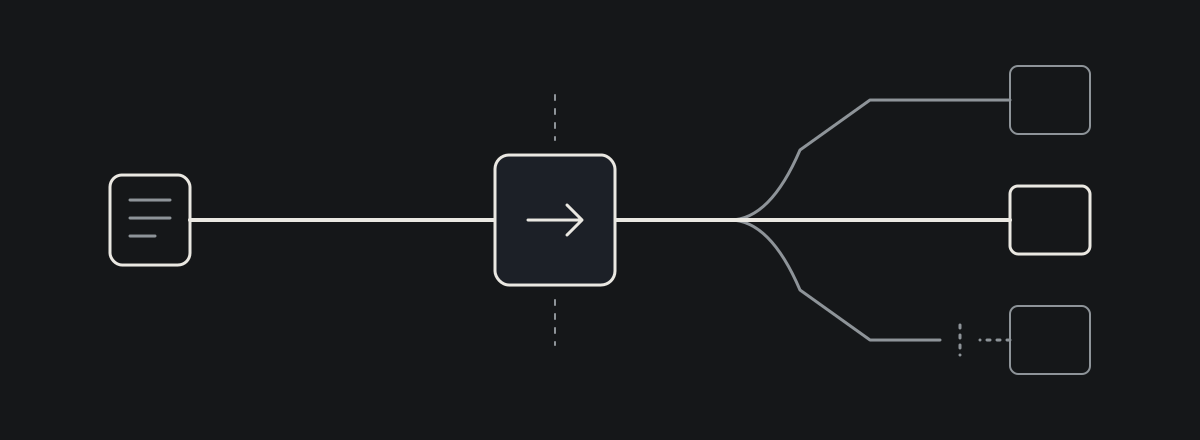
Schematic · not measured data A smaller interface can conceal several decisions about access. Atlas conceptual schematic.
Sources in this version
- The Coasean Singularity? Demand, Supply, and Market Design with AI Agents ↗Author-hosted chapter, listed September 2026 on Shahidi’s publication page · Sections 2, 4 and 6.2; author PDF pp. 4–6, 10–12 and 16–17Published September 2026 · recorded in Atlas 23 October 2026
- Artificial intelligence and competitive dynamics in downstream markets ↗Published 14 November 2025 · Executive summary: Mechanisms supporting competition; Emerging risks, limits and competition concernsPublished 14 November 2025 · recorded in Atlas 23 October 2026
- Welcome to The Back Office ↗Interview consulted on 23 October 2026 · Transcript: response on brokers becoming backends, custom frontends and incentives to trigger tradesPublished 22 July 2026 · recorded in Atlas 23 October 2026
- Google users are less likely to click on links when an AI summary appears in the results ↗Version consulted on 23 October 2026 · Traditional-result clicks and methodologyPublished 22 July 2025 · recorded in Atlas 23 October 2026
- Building an open Agentic Internet ↗Version consulted on 23 October 2026 · Discovery, callable services and transactionsPublished 6 August 2026 · recorded in Atlas 23 October 2026
- Universal Commerce Protocol: specification overview ↗Version consulted on 23 October 2026 · Payment architecture: Trust Triangle, roles and responsibilities; security and authenticationPublished 25 August 2026 · recorded in Atlas 23 October 2026
- Agentic AI and consumers ↗Published 9 March 2026 · Risks, challenges and trust; Wider enablers for positive market developmentPublished 9 March 2026 · recorded in Atlas 23 October 2026
- Agentic Inequality ↗arXiv:2510.16853v4 · Section 2: Availability, Quality and QuantityPublished 5 September 2026 · recorded in Atlas 23 October 2026
- Why the world should stop obsessing over LLMs ↗Interview consulted on 23 October 2026 · Questions about useful applications, local languages, model size and AI4BharatPublished 21 July 2025 · recorded in Atlas 23 October 2026
Where the sources sit in time.
A retrospective selection: publications used in this question and its discovery, ordered by their publication dates. This is a small historical overview, not a complete account of the field or evidence of a research trend.
Why the world should stop obsessing over LLMs ↗
Original interview, edited for clarity and brevity. Nilekani is an Infosys cofounder and supports AI4Bharat. His preference for local-language access and task-specific models is an attributed position, not a benchmark result or a voice for all of India.
Google users are less likely to click on links when an AI summary appears in the results ↗
900 US adults; browsing in March 2025, results reconstructed in April. Query differences may confound the comparison. Not a causal estimate or a current global traffic measure.
Artificial intelligence and competitive dynamics in downstream markets ↗
Institutional synthesis identifies both reduced search/switching costs and risks from access restrictions or biased ranking. Market effects remain context-dependent.
Agentic AI and consumers ↗
UK regulator’s forward-looking analysis. Supports identified steering, interoperability and lock-in risks, not their measured global prevalence.
Welcome to The Back Office ↗
Company-published interview, edited for clarity. Kamath has a commercial interest in Zerodha and its API-enabled brokerage. His forecast about customer interfaces is an operating perspective, not verified adoption or investment advice.
Building an open Agentic Internet ↗
A provider's proposed direction and commercial interest, not proof that websites or traditional search disappear.
Universal Commerce Protocol: specification overview ↗
Specification version date. Described interoperability is not evidence of widespread adoption or independently tested transaction reliability.
The Coasean Singularity? Demand, Supply, and Market Design with AI Agents ↗
Economic argument, not measured welfare effects. Publication month from the author’s page; the PDF itself is undated. Fradkin discloses employment at Amazon; the chapter’s views are the authors’ own.
Agentic Inequality ↗
Version date is 5 September 2026; the manuscript is dated 28 August. Conceptual argument, not empirical measurement of agent access. This article uses the accessible arXiv version, not the later journal text.