What should AI bring to mind right now?
From storing everything to choosing what matters.
MemGPT describes a way to separate stored information from the material in a model’s current context. The system can move information between external memory and a limited context window. It is an architecture worth exploring, not proof that selection always beats a longer history.
This is a suggested direction based on archival research, not a promise of a future discovery. No automatic monitoring has been started.
Architecture described: Storage and current context can be separate
Architecture describedMemGPT distinguishes between a model’s current context and external storage. Information outside the context must be retrieved into it to be included in the model’s next inference.
Scope and conditions: A description of MemGPT v2’s architecture. This is not a claim that it solves Lost in the Middle or is the best approach for every task.
Source passage · 2024“This out-of-context data must always be explicitly moved into main context”
Section 2 distinguishes main context from external context. Sections 2.1–2.4 describe how information moves between them.
Section 2, MemGPT (MemoryGPT), version 2 About the source and its version
What changed, and why.
This history comes from saved content versions. A new revision can be an editorial change; it does not by itself mean that the underlying facts changed.
Editorial change · revision 4
Adds a schematic visual and its source and file record. The explanation and practical advice are unchanged; no new model test is claimed.
No earlier reviewed assessment is available to compare. No change in the underlying facts is being claimed.
Available version records (1)
Revision 4 · Editorial change · reviewed
Adds a schematic visual and its source and file record. The explanation and practical advice are unchanged; no new model test is claimed.
Answer in this version
MemGPT describes a way to separate stored information from the material in a model’s current context. The system can move information between external memory and a limited context window. It is an architecture worth exploring, not proof that selection always beats a longer history.
What remained unresolved
The next investigation would need to compare selection with full history on the same task and model, checking both missed details and incorrectly retrieved information. Atlas has not made that comparison yet.
Takeaway and scope
In the older models studied, fitting information into the context did not guarantee that it would be used reliably.
A study of older models answering questions from documents — not a test of today’s chat products or personal long-term memory.
Position affected the answer
In the study’s document task, accuracy was highest when the document containing the answer came first or last. It declined when the relevant information was in the middle.
Multi-document question answering with 10, 20 or 30 documents; models and versions listed in Section 2.2. This is not an estimate of today’s model performance.
They moved the document, not the answer
The researchers used 2,655 questions from NaturalQuestions-Open. One document contained the annotated answer; other documents served as distractors. They varied the order and number of documents.
Wikipedia passages and a bounded question format. The authors acknowledge that some distractors may still contain reasonable answers and check a less ambiguous subset in Appendix A.
More capacity did not automatically mean better use
When the input fit into both model variants, the models with longer context windows performed roughly like their shorter-context counterparts.
A comparison within the model pairs studied, using inputs that fit into both windows. The study does not show that longer context windows are generally without value.
Storage and current context can be separate
MemGPT distinguishes between a model’s current context and external storage. Information outside the context must be retrieved into it to be included in the model’s next inference.
A description of MemGPT v2’s architecture. This is not a claim that it solves Lost in the Middle or is the best approach for every task.
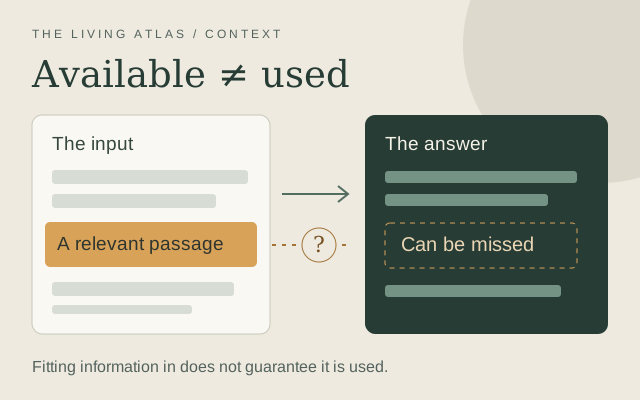
Schematic · not measured data A conceptual illustration of the distinction behind the older context-position study. It shows no measured performance and makes no claim about a current model.
Sources in this version
- Lost in the Middle: How Language Models Use Long Contexts ↗Published TACL article, 2024.tacl-1.9 · Section 2.3, Figure 5, pp. 161–162 (PDF pages 5–6)Published February 2024 · recorded in Atlas 22 October 2026
- Lost in the Middle: How Language Models Use Long Contexts ↗Published TACL article, 2024.tacl-1.9 · Section 2.1, pp. 159–160 (PDF pages 3–4)Published February 2024 · recorded in Atlas 22 October 2026
- Lost in the Middle: How Language Models Use Long Contexts ↗Published TACL article, 2024.tacl-1.9 · Sections 2.2–2.3, pp. 161–162; Section 3.2, p. 163Published February 2024 · recorded in Atlas 22 October 2026
- MemGPT: Towards LLMs as Operating Systems ↗Version 2, 12 February 2024; first version 12 October 2023 · Section 2, MemGPT (MemoryGPT), version 2Published 12 February 2024 · recorded in Atlas 22 October 2026
Where the sources sit in time.
A retrospective selection: publications used in this question and its discovery, ordered by their publication dates. This is a small historical overview, not a complete account of the field or evidence of a research trend.
Lost in the Middle: How Language Models Use Long Contexts ↗
The publication month is listed as 2/2024 on the PDF’s first page. Atlas recorded the source on 22 October 2026; that is not the date of a new research finding.
MemGPT: Towards LLMs as Operating Systems ↗
The date refers to the source version used. Atlas has not run any new performance tests of MemGPT.