Is this workflow right for you?
You need to use an AI-generated answer in a document-based decision, but cannot yet see which parts are supported.
You are working towards: An answer with inspectable source locations, a coverage checklist and unresolved points left visible.
What you’ll need
- Documents you are allowed to use with the chosen tool. Avoid private or confidential material in an unapproved service.
- An assistant that can read the supplied text or files, plus your own access to the originals. The recorded test used pasted text.
- A bounded question and time to inspect the passages behind important conclusions.
The steps
Decide what the answer must cover.
Write your question and a short checklist of essential facts, constraints and disagreements. Keep that checklist outside the model’s answer.
Why this step · The checklist gives you something to compare the answer against, rather than judging fluency alone.
Ask for claims and exact locations.
Ask for the relevant passages first. Require a file name and a page or section; let the model say that support was not found.
Why this step · A location makes a proposed claim inspectable. It is not evidence until you open it.
Adapt this promptFor this question: [your question] Use only the supplied documents. List the relevant claims with file name, page or section, and a short exact passage. Include conflicting evidence. If support is missing, say so; do not invent a location.
Draft from the inspected passages.
Open the passages behind your central points. Reject unsupported interpretations, then ask for a draft that separates supported statements from unresolved points.
Why this step · Inspecting the passage lets you check both its wording and what it means in context.
Check the conclusions, then look for gaps.
Verify every conclusion that matters to the decision and each important number. Compare the answer with your checklist, look for contradictions and leave uncertainty visible. Use extra spot checks to find problems, never to certify the unchecked remainder.
Why this step · Support for individual sentences and coverage of the task are different checks.
A worked example
A fictional policy says: “Invoices above £500 require a manager’s approval.” The question asks whether every invoice needs approval.
Supported: “Invoices above £500 require approval.”
Unresolved: “The supplied passage does not establish the rule for invoices of £500 or less.”
The example illustrates a boundary in the wording. It is not an observed AI response or evidence that the workflow improves accuracy.
Check what matters before using it.
If something does not hold up
A cited passage cannot be found.
Ask for the file and a verifiable location, or remove the claim. The citation may be incorrect; do not guess why.
The quote is real, but the conclusion is broader.
Narrow the conclusion to what the passage supports. Check the surrounding text for exceptions.
The answer ignores a required point.
Return to the coverage checklist and locate relevant support. Leave the point unresolved if none is available.
What this workflow cannot establish.
- The completed test used a separate Codex agent and two short, pasted fictional documents. It did not test long documents, PDF reading, file uploads or use by human readers.
- Matching a quotation does not prove that it supports the surrounding conclusion.
- A checked answer may still omit an important point or a contradictory source.
What has actually been tried?
- Last tested
- 22 October 2026
- Tool
- Separate Codex agent for the completed run; ChatGPT web for four earlier blocked attempts
- Model/version
- Exact model version not exposed. Earlier ChatGPT attempts used High (three attempts) and Medium (one attempt).
- Protocol
- documents-check-v3 · v3 · predefined checks from v1
- Observed outcome
- 1 of 5 recorded runs met the protocol’s checks. This is not a general success rate.
- Next currency review
- 21 December 2026
One complete workflow in a separate Codex agent met the predefined checks: the £500 boundary, software exception, receipts, conflicting note and missing deadline were handled correctly. An Atlas editor agent checked the extracted passages in the original text before requesting a draft, then checked every central conclusion. Four earlier attempts in ChatGPT web ended with an unreadable-response error before any answer could be assessed.
This was one short, fictional case with two pasted documents. The test agent did not inherit the author’s conversation or receive the answer checklist, but it ran with agent instructions; its exact model version was not exposed. No comparison, time saving, general accuracy, long-document handling, PDF reading, file upload or human usability was tested. The four interface failures are not evidence about answer quality. This is not a successful test of the ChatGPT web interface.
Recorded cases and observations
Attempt 1 · ChatGPT web, temporary chat, High · failed
Interface failure: no readable extraction response. No answer quality could be assessed and the draft step was not run.
Attempt 2 · ChatGPT web, new chat, High · failed
Interface failure: the page and copied response contained only the loading error. No complete workflow.
Attempt 3 · ChatGPT web, new chat, High · failed
Interface failure on retry with the same prompt. No readable answer or complete workflow.
Attempt 4 · ChatGPT web, new chat, Medium · failed
Interface failure persisted after reloading; copying the response returned the error text. No complete workflow.
Attempt 5 · Separate Codex agent, extraction then draft · passed
One complete run. The editor checked the quoted passages before requesting a decision note. The final note met all predefined checks, kept the policy conflict visible and left the reimbursement deadline unresolved. No corrective prompt or answer retry was needed.
Background for the workflow
Reported finding: More capacity did not automatically mean better use
Reported findingWhen the input fit into both model variants, the models with longer context windows performed roughly like their shorter-context counterparts.
Scope and conditions: A comparison within the model pairs studied, using inputs that fit into both windows. The study does not show that longer context windows are generally without value.
Source passage · 2024Page 162 compares model pairs when the same input fits into both windows. Model versions are listed on page 161. Exceptions in the key–value task are discussed on page 163.
Sections 2.2–2.3, pp. 161–162; Section 3.2, p. 163 About the source and its version
Follow the answer back to its sources.
Lost in the Middle: How Language Models Use Long Contexts
Nelson F. Liu, Kevin Lin, John Hewitt, Ashwin Paranjape, Michele Bevilacqua, Fabio Petroni and Percy Liang
Transactions of the Association for Computational Linguistics, vol. 12, pp. 157–173 · Published TACL article, 2024.tacl-1.9
The publication month is listed as 2/2024 on the PDF’s first page. Atlas recorded the source on 22 October 2026; that is not the date of a new research finding.
DOI: 10.1162/tacl_a_00638
Source passages, license and conditions ↗
How this version was checked
AI-reviewed by a separate editorial agent · 22 October 2026. The approval applies to revision 3, its text, visuals and source references, including its workflow and test record.
A practical companion to the context Explainer: make document answers inspectable without treating fluent writing or three matching citations as a guarantee.
AI-reviewed by a separate editorial agent · Ask the editor
What changed, and why.
This history comes from saved content versions. A new revision can be an editorial change; it does not by itself mean that the underlying facts changed.
Assessment changed · revision 3
Records one completed workflow test in a separate Codex agent, alongside four earlier ChatGPT interface failures. Adds the observed outcome, limits and next review date.
No earlier reviewed assessment is available to compare. No change in the underlying facts is being claimed.
Available version records (1)
Revision 3 · Assessment changed · reviewed
Records one completed workflow test in a separate Codex agent, alongside four earlier ChatGPT interface failures. Adds the observed outcome, limits and next review date.
Answer in this version
Atlas completed this routine on one short, fictional document case in a separate Codex agent. The answer met the predefined checks. That does not show how reliably the routine works on other tasks; the older context study is background, not validation of these steps.
What remained unresolved
Try the routine on varied document tasks and observe whether people catch consequential errors; the single agent-run example cannot establish that benefit.
Takeaway and scope
Make the answer checkable: define what matters, ask for source locations, then verify each central conclusion in the original.
Tried on one short, fictional document case in a separate Codex agent. It does not establish general accuracy, completeness or an improvement over another method.
More capacity did not automatically mean better use
When the input fit into both model variants, the models with longer context windows performed roughly like their shorter-context counterparts.
A comparison within the model pairs studied, using inputs that fit into both windows. The study does not show that longer context windows are generally without value.
Workflow in this version
Decide what the answer must cover.
Write your question and a short checklist of essential facts, constraints and disagreements. Keep that checklist outside the model’s answer.
The checklist gives you something to compare the answer against, rather than judging fluency alone.
Ask for claims and exact locations.
Ask for the relevant passages first. Require a file name and a page or section; let the model say that support was not found.
A location makes a proposed claim inspectable. It is not evidence until you open it.
For this question: [your question]
Use only the supplied documents. List the relevant claims with file name, page or section, and a short exact passage. Include conflicting evidence. If support is missing, say so; do not invent a location.
Draft from the inspected passages.
Open the passages behind your central points. Reject unsupported interpretations, then ask for a draft that separates supported statements from unresolved points.
Inspecting the passage lets you check both its wording and what it means in context.
Check the conclusions, then look for gaps.
Verify every conclusion that matters to the decision and each important number. Compare the answer with your checklist, look for contradictions and leave uncertainty visible. Use extra spot checks to find problems, never to certify the unchecked remainder.
Support for individual sentences and coverage of the task are different checks.
Result checks
- Each central conclusion has a location you opened in the original document.
- The passage supports the actual meaning of the conclusion, including conditions and exceptions.
- Important numbers match the source and keep their units, dates and scope.
- Every item on your original checklist is answered or explicitly marked unresolved.
- Contradictions and missing support remain visible. Three matching citations do not validate the rest.
Test record
Last tested 22 October 2026 · Separate Codex agent for the completed run; ChatGPT web for four earlier blocked attempts · Exact model version not exposed. Earlier ChatGPT attempts used High (three attempts) and Medium (one attempt).. One complete workflow in a separate Codex agent met the predefined checks: the £500 boundary, software exception, receipts, conflicting note and missing deadline were handled correctly. An Atlas editor agent checked the extracted passages in the original text before requesting a draft, then checked every central conclusion. Four earlier attempts in ChatGPT web ended with an unreadable-response error before any answer could be assessed. This was one short, fictional case with two pasted documents. The test agent did not inherit the author’s conversation or receive the answer checklist, but it ran with agent instructions; its exact model version was not exposed. No comparison, time saving, general accuracy, long-document handling, PDF reading, file upload or human usability was tested. The four interface failures are not evidence about answer quality. This is not a successful test of the ChatGPT web interface.
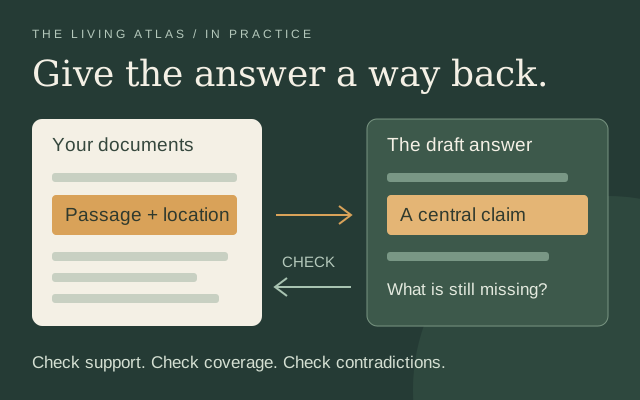
Schematic · not measured data The checking routine: trace central claims to their passages, then look for gaps and contradictions. This is a schematic of the instructions, not a recorded model result.
Sources in this version
- Lost in the Middle: How Language Models Use Long Contexts ↗Published TACL article, 2024.tacl-1.9 · Sections 2.2–2.3, pp. 161–162; Section 3.2, p. 163Published February 2024 · recorded in Atlas 22 October 2026