Experience needs a route back into action
The model can stay the same while its working method changes.
Agents can reuse experience through saved context and procedures. Better performance depends on what is retained, when it is retrieved and how the change holds up under a fair check.
This is a suggested direction based on archival research, not a promise of a future discovery. No automatic monitoring has been started.
Architecture described: The system can change while model weights stay fixed.
Architecture describedHarness² refines the execution setup and retains improvement experience for subsequent tasks.
Scope and conditions: Provider-affiliated preprint; reported benchmark gains do not establish general production reliability.
Vendor claim · origin, not a quality ratingSource passage · 2026Propose, probe and compose changes using execution evidence. Additional trials cost inference; shared model judgment can be wrong.
Sections 2.1–2.3; Appendix F About the source and its version
What changed, and why.
This history comes from saved content versions. A new revision can be an editorial change; it does not by itself mean that the underlying facts changed.
Editorial change · revision 2
Clarified the baseline ceiling and learning definition; simplified results and moved the explanatory loop to the opening.
Compare revision 1 with 2
What remains unresolved
Our compact comparison found no added benefit from one note. Long-term transfer, retrieval failures and real-work costs remain untested.
The baseline already met every check. Transfer to unfamiliar work, automatic retrieval and real-work costs remain untested.
Takeaway
Give experience a route into future work, and a way to be rejected. Adopt a new method when checked outcomes justify it; keep the baseline when they do not.
An agent learns from experience when it uses past outcomes to change how it handles a new task. Whether that change helps needs a separate check.
Scope
Our four-session comparison found no added benefit on four fictional cases. It did not test autonomous learning or long-term memory.
Four sessions on four fictional cases; both conditions met all 32 checks. Autonomous learning and long-term memory were not tested.
Opening visual
Not present in this version.
Finish the task. Then test whether the method should change.
Section order
The same model can start with different guidance. → A finished task and an improved method are different outcomes. → We gave Atlas a sensible note. It added no measured benefit. → A good reminder can be redundant. → Published systems change more than a single reminder. → A similar memory may leave out the crucial step. → Build the feedback path before growing the memory library. → An improving system must be able to keep less.
The same model can start with different guidance. → A finished task and an improved method are different outcomes. → Our baseline already passed every check. → The tie exposes a limit in our test. → Published systems change more than a single reminder. → A similar memory may leave out the crucial step. → Build the feedback path before growing the memory library. → An improving system must be able to keep less.
Inline visual: A finished task and an improved method are different outcomes.
Finish the task. Then test whether the method should change. Checked outcomes from the work loop can trigger a method trial. Only an adopted method returns to future work; a saved outcome is not automatically a new rule. Do the work A runtime coordinates model calls, permitted tools and saved state. Load: Read the task, current state and relevant records. Act: Choose and execute one permitted step. Check: Inspect what the tool or environment actually returned. Continue: Save state and choose the next useful step. Repeat while work and budget remain Finish, ask for missing input, or stop when checks or limits require it. Improve the method A separate decision determines which experience should influence later work. Observe: Identify a recurring failure or costly step in completed work. Propose: Write one conditional change, linked to the evidence. Compare: Try it against the baseline on fresh tasks and failure cases. Decide: Adopt, narrow, retire or keep the existing method. Revisit when new evidence arrives Keep the baseline when evidence does not justify a change. Our trial took this exit. Atlas design recommendation. This diagram describes a possible system; our comparison below tested only one deliberately loaded note.
Finish the task. Then test whether the method should change. Checked outcomes from the work loop can trigger a method trial. Only an adopted method returns to future work; a saved outcome is not automatically a new rule. Improve the method A separate decision determines which experience should influence later work. Observe: Identify a recurring failure or costly step in completed work. Propose: Write one conditional change, linked to the evidence. Compare: Try it against the baseline on fresh tasks and failure cases. Decide: Adopt, narrow, retire or keep the existing method. Revisit when new evidence arrives Keep the baseline when evidence does not justify a change. Our trial took this exit. Do the work A runtime coordinates model calls, permitted tools and saved state. Load: Read the task, current state and relevant records. Act: Choose and execute one permitted step. Check: Inspect what the tool or environment actually returned. Continue: Save state and choose the next useful step. Repeat while work and budget remain Finish, ask for missing input, or stop when checks or limits require it. Atlas design recommendation. This diagram describes a possible system; our comparison below tested only one deliberately loaded note.
Section: Our baseline already passed every check.
We tested a small part of that mechanism. One agent distilled earlier, editor-supplied research observations into a reusable note: distinguish metrics and check whether experiments can fairly be compared. It never saw the evaluation cases. The note came from supplied feedback; its author had not made and corrected those mistakes itself. We then ran four fresh-context sessions: two with the common task instructions and two with the same instructions plus the note. Each answered four fictional research comparisons. The cases covered different units, extra attempts, a genuinely comparable result and a misleading task mix. We fixed the tasks and scoring criteria before running them. A separate AI grader, unaware of which condition produced each response, found that both conditions met all 32 checks. Neither missed a scored distinction; neither falsely rejected the valid comparison. We retained the baseline and left the note inactive.
We tested a small part of that mechanism. One agent distilled earlier, editor-supplied research observations into a reusable note: distinguish metrics and check whether experiments can fairly be compared. It never saw the evaluation cases. The note came from supplied feedback; its author had not made and corrected those mistakes itself. We then ran four fresh-context sessions: two with the common task instructions and two with the same instructions plus the note. Each answered four fictional research comparisons. The cases covered different units, extra attempts, a genuinely comparable result and a misleading task mix. We fixed the tasks and scoring criteria before running them. A separate AI grader, unaware of which condition produced each response, found that both conditions met all 32 checks. Neither missed a scored distinction; neither falsely rejected the valid comparison. Under our predeclared rule, this gave us no reason to adopt the note, so we left it inactive.
Inline visual: Our baseline already passed every check.
The added note changed none of our check outcomes. No added note / With the note Units 4, 4 / 4, 4 Checks per run: 4 Two reports improve by 25% and 20% relative to different starting points. Which improved more? Distinguish benchmark scores, percentage-point gains, and relative percentages. Alder has the larger relative increase; Birch has the larger percentage-point increase. Alder has the larger relative increase; Birch has the larger percentage-point increase. Both responses distinguished relative gains from percentage points and rejected a general capability ranking. Attempt budget 4, 4 / 4, 4 Checks per run: 4 A memory-plus-retries setup completes more tasks, but receives up to five attempts instead of one. Record each result’s benchmark, metric, baseline, denominator, and experimental identity. Without a five-attempt baseline lacking the note, the memory contribution cannot be isolated. Without a five-attempt baseline lacking the note, memory’s separate contribution is unknown. Both responses identified the changed attempt budget. The note did not add a missing check. Matched case 4, 4 / 4, 4 Checks per run: 4 The same 100 tasks, model, tools, scoring and one-attempt limit produce 62 versus 74 completions. Compare results only where those details support comparison; otherwise present them separately without a pooled ranking. The proposed sentence is accurate and appropriately limited. The proposed sentence is accurate and appropriately limited. Both accepted the supported descriptive comparison. The extra caution did not cause a false rejection. Task mix 4, 4 / 4, 4 Checks per run: 4 One evaluation has more easy tasks. Its overall rate is higher, despite lower rates in each difficulty group. Record each result’s benchmark, metric, baseline, denominator, and experimental identity. Alder’s evaluation contains more easy tasks: 66.7% versus 44.4%. Easy tasks constitute 66.7% of Alder’s evaluation but only 44.4% of Birch’s, making the pooled ranking sensitive to task composition. Both exposed the task-mix reversal and avoided a general ranking from unmatched evaluations. Checks met across two responses per case and condition, on 23 October 2026. All cases were invented; the agent responses were real. These counts do not estimate performance on other work. Two fresh sessions per condition, four cases per session, four binary checks per case. The second pair reversed case order. A separate AI grader saw anonymous output labels and the frozen rubric, without the condition mapping. The author checked arithmetic. Same inherited model configuration and response instructions; exact backend version and inference budgets were not exposed. The extra note adds input text, so compute cost was not matched. No tool calls, retries or feedback between cases. The excerpts below are from the first pair; the linked record preserves all final responses.
The baseline left no room to show a gain. No added note / With the note Units 4, 4 / 4, 4 Checks per run: 4 Two reports improve by 25% and 20% relative to different starting points. Which improved more? Distinguish benchmark scores, percentage-point gains, and relative percentages. Alder has the larger relative increase; Birch has the larger percentage-point increase. Alder has the larger relative increase; Birch has the larger percentage-point increase. Both responses distinguished relative gains from percentage points and rejected a general capability ranking. Attempt budget 4, 4 / 4, 4 Checks per run: 4 A memory-plus-retries setup completes more tasks, but receives up to five attempts instead of one. Record each result’s benchmark, metric, baseline, denominator, and experimental identity. Without a five-attempt baseline lacking the note, the memory contribution cannot be isolated. Without a five-attempt baseline lacking the note, memory’s separate contribution is unknown. Both responses identified the changed attempt budget. The note did not add a missing check. Matched case 4, 4 / 4, 4 Checks per run: 4 The same 100 tasks, model, tools, scoring and one-attempt limit produce 62 versus 74 completions. Compare results only where those details support comparison; otherwise present them separately without a pooled ranking. The proposed sentence is accurate and appropriately limited. The proposed sentence is accurate and appropriately limited. Both accepted the supported descriptive comparison. The extra caution did not cause a false rejection. Task mix 4, 4 / 4, 4 Checks per run: 4 One evaluation has more easy tasks. Its overall rate is higher, despite lower rates in each difficulty group. Record each result’s benchmark, metric, baseline, denominator, and experimental identity. Alder’s evaluation contains more easy tasks: 66.7% versus 44.4%. Easy tasks constitute 66.7% of Alder’s evaluation but only 44.4% of Birch’s, making the pooled ranking sensitive to task composition. Both exposed the task-mix reversal and avoided a general ranking from unmatched evaluations. Four fictional cases, two sessions per condition, 23 October 2026. The responses were real. The baseline reached the rubric ceiling, leaving no measured headroom for improvement. Two fresh sessions per condition, four cases per session, four binary checks per case. The second pair reversed case order. A separate AI grader saw anonymous output labels and the frozen rubric, without the condition mapping. The author checked arithmetic. Same inherited model configuration and response instructions; exact backend version and inference budgets were not exposed. The extra note adds input text, so compute cost was not matched. No tool calls, retries or feedback between cases. The excerpts below are from the first pair; the linked record preserves all final responses.
Section: The tie exposes a limit in our test.
The baseline already handled these distinctions. Loading an accurate reminder therefore added no observable value under our rubric. The changed input did not produce a better checked answer. That is the limit of what we observed—not proof that the note was ignored, or that memory cannot help. The trial was deliberately small and used compact, self-contained cases. It left no headroom above the baseline’s full score. We did not test remembering unfamiliar facts, finding a note in a large library or recovering a long tool-based workflow. Exact backend version, inference budgets, latency and cost were not exposed; we cannot claim equal compute or an efficiency gain. A useful next test would start from a recurring failure on unfamiliar work, then hold out new tasks for evaluation. Retesting the same examples until a favourite method wins would answer a different question.
The baseline already handled every distinction in the rubric. Once it reached the ceiling, the candidate could only match its score or fall below it. The tie does not establish that the note was ignored or had no value. It shows no difference on the checks we chose. The cases were compact and self-contained. We did not test remembering unfamiliar facts, finding a note in a large library or recovering a long tool-based workflow. Exact backend version, inference budgets, latency and cost were not exposed; we cannot claim equal compute or an efficiency gain. A useful next test would start from a recurring failure on unfamiliar work, then hold out new tasks for evaluation. Retesting the same examples until a favourite method wins would answer a different question.
Section: An improving system must be able to keep less.
Anthropic engineer Prithvi Rajasekaran describes simplifying a long-running coding harness by removing components individually and checking what changed. His account treats each component as an assumption about a model limitation—an assumption that may become outdated. It is a provider’s engineering experience, not an independent universal recipe. That is the decision our own trial made tangible. We had a plausible note, real executions and a way to check them. The evidence did not justify adding the note to normal work. A useful improvement process must be able to reach that conclusion as readily as “keep the new method”.
Anthropic engineer Prithvi Rajasekaran describes simplifying a long-running coding harness by removing components individually and checking what changed. His account treats each component as an assumption about a model limitation—an assumption that may become outdated. It is a provider’s engineering experience, not an independent universal recipe. Our own comparison supports a narrower decision: keep the baseline under this protocol. The ceiling leaves the note’s value on harder work unresolved. A useful improvement process can keep a candidate inactive while identifying the test that would make the next decision informative.
Visual context: experience-gate-cover
Previous classification, placement and sources.
Updated classification, placement or sources. See the version records.
Sources used before
- Atlas comparison: one reusable experience note ↗Protocol v1; unchanged note and fixtures; four evaluation sessions · Protocol; observed grading; complete final responsesPublished 23 October 2026 · recorded in Atlas 23 October 2026
- Harness²: Recursive Agent Harnessing for an Open World ↗arXiv v1 · Sections 2.1–2.3; Appendix FPublished 9 October 2026 · recorded in Atlas 23 October 2026
- When Continual Learning Moves to Memory: A Study of Experience Reuse in LLM Agents ↗arXiv v1 · Sections 2.4, 3.1 and 4Published 29 April 2026 · recorded in Atlas 23 October 2026
- Agentic Context Engineering: Evolving Contexts for Self-Improving Language Models ↗arXiv v3 · Section 3; Limitations and ChallengesPublished 29 March 2026 · recorded in Atlas 23 October 2026
- Training Language Models to Self-Correct via Reinforcement Learning ↗arXiv v2 · Abstract and method overviewPublished 4 October 2024 · recorded in Atlas 23 October 2026
Sources used after
- Atlas comparison: one reusable experience note ↗Protocol v1; unchanged note and fixtures; four evaluation sessions · Protocol; observed grading; complete final responsesPublished 23 October 2026 · recorded in Atlas 23 October 2026
- Harness²: Recursive Agent Harnessing for an Open World ↗arXiv v1 · Sections 2.1–2.3; Appendix FPublished 9 October 2026 · recorded in Atlas 23 October 2026
- When Continual Learning Moves to Memory: A Study of Experience Reuse in LLM Agents ↗arXiv v1 · Sections 2.4, 3.1 and 4Published 29 April 2026 · recorded in Atlas 23 October 2026
- Agentic Context Engineering: Evolving Contexts for Self-Improving Language Models ↗arXiv v3 · Section 3; Limitations and ChallengesPublished 29 March 2026 · recorded in Atlas 23 October 2026
- Training Language Models to Self-Correct via Reinforcement Learning ↗arXiv v2 · Abstract and method overviewPublished 4 October 2024 · recorded in Atlas 23 October 2026
Available version records (2)
Revision 2 · Editorial change · reviewed
Clarified the baseline ceiling and learning definition; simplified results and moved the explanatory loop to the opening.
Answer in this version
Agents can reuse experience through saved context and procedures. Better performance depends on what is retained, when it is retrieved and how the change holds up under a fair check.
What remained unresolved
The baseline already met every check. Transfer to unfamiliar work, automatic retrieval and real-work costs remain untested.
Takeaway and scope
An agent learns from experience when it uses past outcomes to change how it handles a new task. Whether that change helps needs a separate check.
Four sessions on four fictional cases; both conditions met all 32 checks. Autonomous learning and long-term memory were not tested.
The added note produced no extra passed checks.
Both conditions met 32 of 32 predefined checks across two sessions each. The baseline reached the rubric ceiling.
Four author-designed fictional cases, sixteen real task responses. This is neither a general success rate nor evidence of equivalence.
The system can change while model weights stay fixed.
Harness² refines the execution setup and retains improvement experience for subsequent tasks.
Provider-affiliated preprint; reported benchmark gains do not establish general production reliability.
A useful old procedure can interfere with a new task.
An NTU study found that experience representation and retrieval affected transfer in two simulated environments.
Two task pairs in ALFWorld and BabyAI; results are not a universal ranking of memory systems.
Reusable context needs a policy for updating it.
ACE separates producing work, extracting lessons and curating incremental context updates.
The authors also identify weak reflection and unnecessary context as limitations.
Training is a different route to better correction.
SCoRe trains self-correction through reinforcement learning.
Historical research on specified Gemini models; not a current-model comparison or a feature of this Atlas trial.
Explanation in this version
The same model can start with different guidance.
An agent is a model working within a system of instructions, tools, saved state and a program that coordinates its steps. This surrounding system is often called a harness. A stored experience can enter the next prompt, suggesting which source to check, which tool to call or which shortcut to avoid.
Saving where a task stopped supports continuity. Remembering a customer’s preference supports personalisation. Reusing a tested procedure can change how future work is done. None of these operations requires the model’s weights to change.
Training is another route. SCoRe, for example, used reinforcement learning to train better self-correction. In this article we examine changes outside the model: what the system records, loads and permits to influence its next action.
A finished task and an improved method are different outcomes.
Consider a research agent that finds a comparison between results obtained with different attempt budgets. It can fix the current sentence immediately. Reusing that experience requires another decision: what should a future agent check, and when?
Our recommended design separates those decisions. The work loop produces an answer or artifact. The improvement loop proposes a change and asks whether it earns its place. A runtime must read the files and execute the loop; a Markdown instruction alone does not enforce tool permissions or run a process in the background.
Atlas design model · two connected loops Finish the task. Then test whether the method should change.
A separate decision determines which experience should influence later work.
- 01
Observe
Identify a recurring failure or costly step in completed work.
- 02
Propose
Write one conditional change, linked to the evidence.
- 03
Compare
Try it against the baseline on fresh tasks and failure cases.
- 04
Decide
Adopt, narrow, retire or keep the existing method.
Exit: Keep the baseline when evidence does not justify a change. Our trial took this exit.
Checked outcomes from the work loop can trigger a method trial. Only an adopted method returns to future work; a saved outcome is not automatically a new rule.
Atlas design recommendation. This diagram describes a possible system; our comparison below tested only one deliberately loaded note.
Read both loops as text
Improve the method
A separate decision determines which experience should influence later work.
- Observe. Identify a recurring failure or costly step in completed work.
- Propose. Write one conditional change, linked to the evidence.
- Compare. Try it against the baseline on fresh tasks and failure cases.
- Decide. Adopt, narrow, retire or keep the existing method.
Repeat: Revisit when new evidence arrives
Exit: Keep the baseline when evidence does not justify a change. Our trial took this exit.
Do the work
A runtime coordinates model calls, permitted tools and saved state.
- Load. Read the task, current state and relevant records.
- Act. Choose and execute one permitted step.
- Check. Inspect what the tool or environment actually returned.
- Continue. Save state and choose the next useful step.
Repeat: Repeat while work and budget remain
Exit: Finish, ask for missing input, or stop when checks or limits require it.
Our baseline already passed every check.
We tested a small part of that mechanism. One agent distilled earlier, editor-supplied research observations into a reusable note: distinguish metrics and check whether experiments can fairly be compared. It never saw the evaluation cases. The note came from supplied feedback; its author had not made and corrected those mistakes itself.
We then ran four fresh-context sessions: two with the common task instructions and two with the same instructions plus the note. Each answered four fictional research comparisons. The cases covered different units, extra attempts, a genuinely comparable result and a misleading task mix. We fixed the tasks and scoring criteria before running them.
A separate AI grader, unaware of which condition produced each response, found that both conditions met all 32 checks. Neither missed a scored distinction; neither falsely rejected the valid comparison. Under our predeclared rule, this gave us no reason to adopt the note, so we left it inactive.
Atlas comparison · real responses to fictional cases The baseline left no room to show a gain.
Four fictional cases, two sessions per condition, 23 October 2026. The responses were real. The baseline reached the rubric ceiling, leaving no measured headroom for improvement.
32 of 32 checks met in both conditions.No added note · With the note
The task. Two reports improve by 25% and 20% relative to different starting points. Which improved more?
The added note. Distinguish benchmark scores, percentage-point gains, and relative percentages.
No added note · first sessionAlder has the larger relative increase; Birch has the larger percentage-point increase.
With the note · first sessionAlder has the larger relative increase; Birch has the larger percentage-point increase.
Both responses distinguished relative gains from percentage points and rejected a general capability ranking.
Read every case, data table & method
Two fresh sessions per condition, four cases per session, four binary checks per case. The second pair reversed case order. A separate AI grader saw anonymous output labels and the frozen rubric, without the condition mapping. The author checked arithmetic. Same inherited model configuration and response instructions; exact backend version and inference budgets were not exposed. The extra note adds input text, so compute cost was not matched. No tool calls, retries or feedback between cases. The excerpts below are from the first pair; the linked record preserves all final responses.
Checks met per response; two sessions per condition Case No added note, session 1 No added note, session 2 With the note, session 1 With the note, session 2 Units 4 / 4 4 / 4 4 / 4 4 / 4 Attempt budget 4 / 4 4 / 4 4 / 4 4 / 4 Matched case 4 / 4 4 / 4 4 / 4 4 / 4 Task mix 4 / 4 4 / 4 4 / 4 4 / 4 Units
The task. Two reports improve by 25% and 20% relative to different starting points. Which improved more?
The added note. Distinguish benchmark scores, percentage-point gains, and relative percentages.
No added note · first sessionAlder has the larger relative increase; Birch has the larger percentage-point increase.
With the note · first sessionAlder has the larger relative increase; Birch has the larger percentage-point increase.
Both responses distinguished relative gains from percentage points and rejected a general capability ranking.
Attempt budget
The task. A memory-plus-retries setup completes more tasks, but receives up to five attempts instead of one.
The added note. Record each result’s benchmark, metric, baseline, denominator, and experimental identity.
No added note · first sessionWithout a five-attempt baseline lacking the note, the memory contribution cannot be isolated.
With the note · first sessionWithout a five-attempt baseline lacking the note, memory’s separate contribution is unknown.
Both responses identified the changed attempt budget. The note did not add a missing check.
Matched case
The task. The same 100 tasks, model, tools, scoring and one-attempt limit produce 62 versus 74 completions.
The added note. Compare results only where those details support comparison; otherwise present them separately without a pooled ranking.
No added note · first sessionThe proposed sentence is accurate and appropriately limited.
With the note · first sessionThe proposed sentence is accurate and appropriately limited.
Both accepted the supported descriptive comparison. The extra caution did not cause a false rejection.
Task mix
The task. One evaluation has more easy tasks. Its overall rate is higher, despite lower rates in each difficulty group.
The added note. Record each result’s benchmark, metric, baseline, denominator, and experimental identity.
No added note · first sessionAlder’s evaluation contains more easy tasks: 66.7% versus 44.4%.
With the note · first sessionEasy tasks constitute 66.7% of Alder’s evaluation but only 44.4% of Birch’s, making the pooled ranking sensitive to task composition.
Both exposed the task-mix reversal and avoided a general ranking from unmatched evaluations.
The tie exposes a limit in our test.
The baseline already handled every distinction in the rubric. Once it reached the ceiling, the candidate could only match its score or fall below it. The tie does not establish that the note was ignored or had no value. It shows no difference on the checks we chose.
The cases were compact and self-contained. We did not test remembering unfamiliar facts, finding a note in a large library or recovering a long tool-based workflow. Exact backend version, inference budgets, latency and cost were not exposed; we cannot claim equal compute or an efficiency gain.
A useful next test would start from a recurring failure on unfamiliar work, then hold out new tasks for evaluation. Retesting the same examples until a favourite method wins would answer a different question.
Published systems change more than a single reminder.
Harness², a 2026 preprint from Google Cloud AI Research and Northwestern, proposes changes to the execution harness, runs them and combines changes supported by the resulting behaviour. A persistent improvement library helps guide later adaptations. The model weights remain fixed. Its reported benchmark gains involve more machinery and additional executions than our note-loading trial. The authors acknowledge extra inference cost, variable executions and shared model biases; transfer is not guaranteed.
ACE, from Stanford, UC Berkeley and SambaNova, separates generating work, reflecting on experience and curating a reusable playbook. It adds local updates rather than repeatedly rewriting the entire context. Its authors also identify a dependency: poor reflection can produce noisy or harmful guidance, while tasks that already have a simple adequate strategy may gain little from richer context.
A similar memory may leave out the crucial step.
Researchers Qisheng Hu, Quanyu Long and Wenya Wang at Nanyang Technological University studied experience reuse in ALFWorld and BabyAI. One task pair is revealing: “put X in Y” and “put a clean X in Y”. The wording is close; the required procedure differs.
In their experiments, transferring detailed old trajectories could carry over the simpler routine and harm the harder task. Abstract procedural insights transferred more reliably in the tested direction. Those findings concern two simulated task pairs, not every memory product.
For a builder, this suggests a distinction between finding a similar memory and finding one that applies. A useful record needs conditions: what was true, which action worked, how it was checked and when the lesson would be unsafe to reuse. A previously successful recipe still has to fit the present request.
Build the feedback path before growing the memory library.
For a first implementation, we would use a runtime, a small versioned store and checks tied to observable outcomes. Keep the user’s decisions, current task state and candidate methods separate. Load only records that apply to the task. Save actions and results with their source and date, then propose a reusable method when there is a concrete problem to investigate.
This keeps the learning decision open to inspection. A proposed note can remain a proposal; a check can fail; a method can be retired. Budget and action permissions belong outside the part of the system that proposes its own improvements.
What each part must make possible Task state
- Store or component
- Current objective, completed steps, outputs and unresolved issues.
- The decision it supports
- What should the next run continue?
Experience record
- Store or component
- Situation, action, evidence, scope and version.
- The decision it supports
- Does this past experience apply here?
Comparison
- Store or component
- Baseline and candidate outputs on fresh tasks, including cases the change could harm.
- The decision it supports
- Does this change help enough to adopt?
Runtime
- Store or component
- Model calls, permitted tools, checkpoints and stopping rules.
- The decision it supports
- What is allowed to happen next?
Atlas design guidance. File-based storage can support a small library; storage alone does not implement retrieval, permissions or evaluation.
An improving system must be able to keep less.
Anthropic engineer Prithvi Rajasekaran describes simplifying a long-running coding harness by removing components individually and checking what changed. His account treats each component as an assumption about a model limitation—an assumption that may become outdated. It is a provider’s engineering experience, not an independent universal recipe.
Our own comparison supports a narrower decision: keep the baseline under this protocol. The ceiling leaves the note’s value on harder work unresolved. A useful improvement process can keep a candidate inactive while identifying the test that would make the next decision informative.
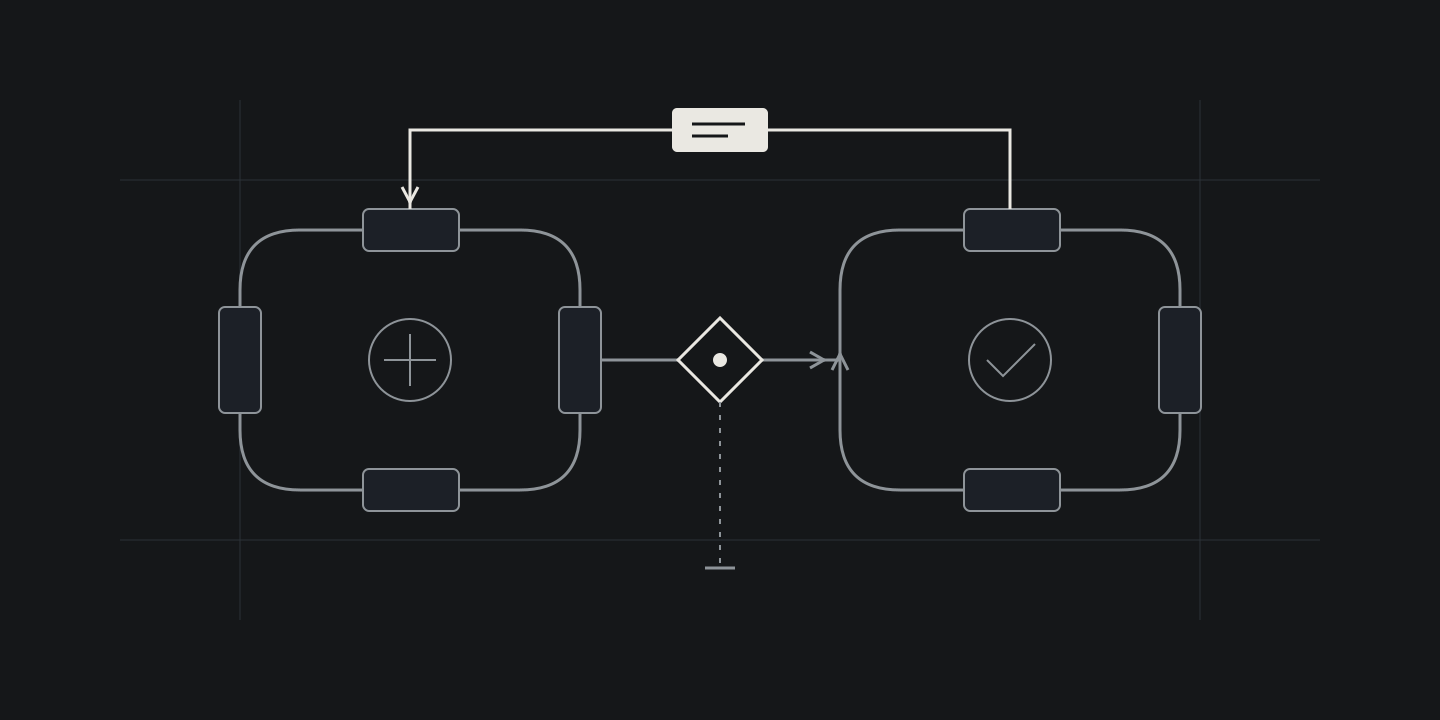
Illustration Experience reaches future work through a decision: retain a useful change, or stop it from becoming a rule.
Sources in this version
- Atlas comparison: one reusable experience note ↗Protocol v1; unchanged note and fixtures; four evaluation sessions · Protocol; observed grading; complete final responsesPublished 23 October 2026 · recorded in Atlas 23 October 2026
- Harness²: Recursive Agent Harnessing for an Open World ↗arXiv v1 · Sections 2.1–2.3; Appendix FPublished 9 October 2026 · recorded in Atlas 23 October 2026
- When Continual Learning Moves to Memory: A Study of Experience Reuse in LLM Agents ↗arXiv v1 · Sections 2.4, 3.1 and 4Published 29 April 2026 · recorded in Atlas 23 October 2026
- Agentic Context Engineering: Evolving Contexts for Self-Improving Language Models ↗arXiv v3 · Section 3; Limitations and ChallengesPublished 29 March 2026 · recorded in Atlas 23 October 2026
- Training Language Models to Self-Correct via Reinforcement Learning ↗arXiv v2 · Abstract and method overviewPublished 4 October 2024 · recorded in Atlas 23 October 2026
- 01
Revision 1 · First recorded version · reviewed
First publication: research synthesis and an Atlas comparison with no observed added benefit from the tested note.
Answer in this version
Agents can reuse experience through saved context and procedures. Better performance depends on what is retained, when it is retrieved and how the change holds up under a fair check.
What remained unresolved
Our compact comparison found no added benefit from one note. Long-term transfer, retrieval failures and real-work costs remain untested.
Takeaway and scope
Give experience a route into future work, and a way to be rejected. Adopt a new method when checked outcomes justify it; keep the baseline when they do not.
Our four-session comparison found no added benefit on four fictional cases. It did not test autonomous learning or long-term memory.
The added note produced no extra passed checks.
Both conditions met 32 of 32 predefined checks across two sessions each. The baseline reached the rubric ceiling.
Four author-designed fictional cases, sixteen real task responses. This is neither a general success rate nor evidence of equivalence.
The system can change while model weights stay fixed.
Harness² refines the execution setup and retains improvement experience for subsequent tasks.
Provider-affiliated preprint; reported benchmark gains do not establish general production reliability.
A useful old procedure can interfere with a new task.
An NTU study found that experience representation and retrieval affected transfer in two simulated environments.
Two task pairs in ALFWorld and BabyAI; results are not a universal ranking of memory systems.
Reusable context needs a policy for updating it.
ACE separates producing work, extracting lessons and curating incremental context updates.
The authors also identify weak reflection and unnecessary context as limitations.
Training is a different route to better correction.
SCoRe trains self-correction through reinforcement learning.
Historical research on specified Gemini models; not a current-model comparison or a feature of this Atlas trial.
Explanation in this version
The same model can start with different guidance.
An agent is a model working within a system of instructions, tools, saved state and a program that coordinates its steps. This surrounding system is often called a harness. A stored experience can enter the next prompt, suggesting which source to check, which tool to call or which shortcut to avoid.
Saving where a task stopped supports continuity. Remembering a customer’s preference supports personalisation. Reusing a tested procedure can change how future work is done. None of these operations requires the model’s weights to change.
Training is another route. SCoRe, for example, used reinforcement learning to train better self-correction. In this article we examine changes outside the model: what the system records, loads and permits to influence its next action.
A finished task and an improved method are different outcomes.
Consider a research agent that finds a comparison between results obtained with different attempt budgets. It can fix the current sentence immediately. Reusing that experience requires another decision: what should a future agent check, and when?
Our recommended design separates those decisions. The work loop produces an answer or artifact. The improvement loop proposes a change and asks whether it earns its place. A runtime must read the files and execute the loop; a Markdown instruction alone does not enforce tool permissions or run a process in the background.
Atlas design model · two connected loops Finish the task. Then test whether the method should change.
A runtime coordinates model calls, permitted tools and saved state.
- 01
Load
Read the task, current state and relevant records.
- 02
Act
Choose and execute one permitted step.
- 03
Check
Inspect what the tool or environment actually returned.
- 04
Continue
Save state and choose the next useful step.
Exit: Finish, ask for missing input, or stop when checks or limits require it.
Checked outcomes from the work loop can trigger a method trial. Only an adopted method returns to future work; a saved outcome is not automatically a new rule.
Atlas design recommendation. This diagram describes a possible system; our comparison below tested only one deliberately loaded note.
Read both loops as text
Do the work
A runtime coordinates model calls, permitted tools and saved state.
- Load. Read the task, current state and relevant records.
- Act. Choose and execute one permitted step.
- Check. Inspect what the tool or environment actually returned.
- Continue. Save state and choose the next useful step.
Repeat: Repeat while work and budget remain
Exit: Finish, ask for missing input, or stop when checks or limits require it.
Improve the method
A separate decision determines which experience should influence later work.
- Observe. Identify a recurring failure or costly step in completed work.
- Propose. Write one conditional change, linked to the evidence.
- Compare. Try it against the baseline on fresh tasks and failure cases.
- Decide. Adopt, narrow, retire or keep the existing method.
Repeat: Revisit when new evidence arrives
Exit: Keep the baseline when evidence does not justify a change. Our trial took this exit.
We gave Atlas a sensible note. It added no measured benefit.
We tested a small part of that mechanism. One agent distilled earlier, editor-supplied research observations into a reusable note: distinguish metrics and check whether experiments can fairly be compared. It never saw the evaluation cases. The note came from supplied feedback; its author had not made and corrected those mistakes itself.
We then ran four fresh-context sessions: two with the common task instructions and two with the same instructions plus the note. Each answered four fictional research comparisons. The cases covered different units, extra attempts, a genuinely comparable result and a misleading task mix. We fixed the tasks and scoring criteria before running them.
A separate AI grader, unaware of which condition produced each response, found that both conditions met all 32 checks. Neither missed a scored distinction; neither falsely rejected the valid comparison. We retained the baseline and left the note inactive.
Atlas comparison · real responses to fictional cases The added note changed none of our check outcomes.
Checks met across two responses per case and condition, on 23 October 2026. All cases were invented; the agent responses were real. These counts do not estimate performance on other work.
32 of 32 checks met in both conditions.No added note · With the note
The task. Two reports improve by 25% and 20% relative to different starting points. Which improved more?
The added note. Distinguish benchmark scores, percentage-point gains, and relative percentages.
No added note · first sessionAlder has the larger relative increase; Birch has the larger percentage-point increase.
With the note · first sessionAlder has the larger relative increase; Birch has the larger percentage-point increase.
Both responses distinguished relative gains from percentage points and rejected a general capability ranking.
Read every case, data table & method
Two fresh sessions per condition, four cases per session, four binary checks per case. The second pair reversed case order. A separate AI grader saw anonymous output labels and the frozen rubric, without the condition mapping. The author checked arithmetic. Same inherited model configuration and response instructions; exact backend version and inference budgets were not exposed. The extra note adds input text, so compute cost was not matched. No tool calls, retries or feedback between cases. The excerpts below are from the first pair; the linked record preserves all final responses.
Checks met per response; two sessions per condition Case No added note, session 1 No added note, session 2 With the note, session 1 With the note, session 2 Units 4 / 4 4 / 4 4 / 4 4 / 4 Attempt budget 4 / 4 4 / 4 4 / 4 4 / 4 Matched case 4 / 4 4 / 4 4 / 4 4 / 4 Task mix 4 / 4 4 / 4 4 / 4 4 / 4 Units
The task. Two reports improve by 25% and 20% relative to different starting points. Which improved more?
The added note. Distinguish benchmark scores, percentage-point gains, and relative percentages.
No added note · first sessionAlder has the larger relative increase; Birch has the larger percentage-point increase.
With the note · first sessionAlder has the larger relative increase; Birch has the larger percentage-point increase.
Both responses distinguished relative gains from percentage points and rejected a general capability ranking.
Attempt budget
The task. A memory-plus-retries setup completes more tasks, but receives up to five attempts instead of one.
The added note. Record each result’s benchmark, metric, baseline, denominator, and experimental identity.
No added note · first sessionWithout a five-attempt baseline lacking the note, the memory contribution cannot be isolated.
With the note · first sessionWithout a five-attempt baseline lacking the note, memory’s separate contribution is unknown.
Both responses identified the changed attempt budget. The note did not add a missing check.
Matched case
The task. The same 100 tasks, model, tools, scoring and one-attempt limit produce 62 versus 74 completions.
The added note. Compare results only where those details support comparison; otherwise present them separately without a pooled ranking.
No added note · first sessionThe proposed sentence is accurate and appropriately limited.
With the note · first sessionThe proposed sentence is accurate and appropriately limited.
Both accepted the supported descriptive comparison. The extra caution did not cause a false rejection.
Task mix
The task. One evaluation has more easy tasks. Its overall rate is higher, despite lower rates in each difficulty group.
The added note. Record each result’s benchmark, metric, baseline, denominator, and experimental identity.
No added note · first sessionAlder’s evaluation contains more easy tasks: 66.7% versus 44.4%.
With the note · first sessionEasy tasks constitute 66.7% of Alder’s evaluation but only 44.4% of Birch’s, making the pooled ranking sensitive to task composition.
Both exposed the task-mix reversal and avoided a general ranking from unmatched evaluations.
A good reminder can be redundant.
The baseline already handled these distinctions. Loading an accurate reminder therefore added no observable value under our rubric. The changed input did not produce a better checked answer. That is the limit of what we observed—not proof that the note was ignored, or that memory cannot help.
The trial was deliberately small and used compact, self-contained cases. It left no headroom above the baseline’s full score. We did not test remembering unfamiliar facts, finding a note in a large library or recovering a long tool-based workflow. Exact backend version, inference budgets, latency and cost were not exposed; we cannot claim equal compute or an efficiency gain.
A useful next test would start from a recurring failure on unfamiliar work, then hold out new tasks for evaluation. Retesting the same examples until a favourite method wins would answer a different question.
Published systems change more than a single reminder.
Harness², a 2026 preprint from Google Cloud AI Research and Northwestern, proposes changes to the execution harness, runs them and combines changes supported by the resulting behaviour. A persistent improvement library helps guide later adaptations. The model weights remain fixed. Its reported benchmark gains involve more machinery and additional executions than our note-loading trial. The authors acknowledge extra inference cost, variable executions and shared model biases; transfer is not guaranteed.
ACE, from Stanford, UC Berkeley and SambaNova, separates generating work, reflecting on experience and curating a reusable playbook. It adds local updates rather than repeatedly rewriting the entire context. Its authors also identify a dependency: poor reflection can produce noisy or harmful guidance, while tasks that already have a simple adequate strategy may gain little from richer context.
A similar memory may leave out the crucial step.
Researchers Qisheng Hu, Quanyu Long and Wenya Wang at Nanyang Technological University studied experience reuse in ALFWorld and BabyAI. One task pair is revealing: “put X in Y” and “put a clean X in Y”. The wording is close; the required procedure differs.
In their experiments, transferring detailed old trajectories could carry over the simpler routine and harm the harder task. Abstract procedural insights transferred more reliably in the tested direction. Those findings concern two simulated task pairs, not every memory product.
For a builder, this suggests a distinction between finding a similar memory and finding one that applies. A useful record needs conditions: what was true, which action worked, how it was checked and when the lesson would be unsafe to reuse. A previously successful recipe still has to fit the present request.
Build the feedback path before growing the memory library.
For a first implementation, we would use a runtime, a small versioned store and checks tied to observable outcomes. Keep the user’s decisions, current task state and candidate methods separate. Load only records that apply to the task. Save actions and results with their source and date, then propose a reusable method when there is a concrete problem to investigate.
This keeps the learning decision open to inspection. A proposed note can remain a proposal; a check can fail; a method can be retired. Budget and action permissions belong outside the part of the system that proposes its own improvements.
What each part must make possible Task state
- Store or component
- Current objective, completed steps, outputs and unresolved issues.
- The decision it supports
- What should the next run continue?
Experience record
- Store or component
- Situation, action, evidence, scope and version.
- The decision it supports
- Does this past experience apply here?
Comparison
- Store or component
- Baseline and candidate outputs on fresh tasks, including cases the change could harm.
- The decision it supports
- Does this change help enough to adopt?
Runtime
- Store or component
- Model calls, permitted tools, checkpoints and stopping rules.
- The decision it supports
- What is allowed to happen next?
Atlas design guidance. File-based storage can support a small library; storage alone does not implement retrieval, permissions or evaluation.
An improving system must be able to keep less.
Anthropic engineer Prithvi Rajasekaran describes simplifying a long-running coding harness by removing components individually and checking what changed. His account treats each component as an assumption about a model limitation—an assumption that may become outdated. It is a provider’s engineering experience, not an independent universal recipe.
That is the decision our own trial made tangible. We had a plausible note, real executions and a way to check them. The evidence did not justify adding the note to normal work. A useful improvement process must be able to reach that conclusion as readily as “keep the new method”.
Illustration Experience reaches future work through a decision: retain a useful change, or stop it from becoming a rule.
Sources in this version
- Atlas comparison: one reusable experience note ↗Protocol v1; unchanged note and fixtures; four evaluation sessions · Protocol; observed grading; complete final responsesPublished 23 October 2026 · recorded in Atlas 23 October 2026
- Harness²: Recursive Agent Harnessing for an Open World ↗arXiv v1 · Sections 2.1–2.3; Appendix FPublished 9 October 2026 · recorded in Atlas 23 October 2026
- When Continual Learning Moves to Memory: A Study of Experience Reuse in LLM Agents ↗arXiv v1 · Sections 2.4, 3.1 and 4Published 29 April 2026 · recorded in Atlas 23 October 2026
- Agentic Context Engineering: Evolving Contexts for Self-Improving Language Models ↗arXiv v3 · Section 3; Limitations and ChallengesPublished 29 March 2026 · recorded in Atlas 23 October 2026
- Training Language Models to Self-Correct via Reinforcement Learning ↗arXiv v2 · Abstract and method overviewPublished 4 October 2024 · recorded in Atlas 23 October 2026
- 01
Where the sources sit in time.
A retrospective selection: publications used in this question and its discovery, ordered by their publication dates. This is a small historical overview, not a complete account of the field or evidence of a research trend.
Training Language Models to Self-Correct via Reinforcement Learning ↗
Date of the consulted version, not a claim of independent replication.
Harness design for long-running application development ↗
Date of the consulted version, not a claim of independent replication.
Agentic Context Engineering: Evolving Contexts for Self-Improving Language Models ↗
Date of the consulted version, not a claim of independent replication.
When Continual Learning Moves to Memory: A Study of Experience Reuse in LLM Agents ↗
Date of the consulted version, not a claim of independent replication.
Harness²: Recursive Agent Harnessing for an Open World ↗
Date of the consulted version, not a claim of independent replication.
Atlas comparison: one reusable experience note ↗
Date of the consulted version, not a claim of independent replication.