Experience becomes an asset when it can change how the company works.
A firm can retrieve every decision it ever made and still repeat the wrong one. The opportunity is to connect experience to new decisions without turning yesterday’s explanation into today’s unquestioned rule.
A company can remember a mistake perfectly.
A team concludes that falling sales mean it should hold less stock. Purchasing cuts its order. Sales fall again. An AI assistant retrieves the earlier decision and recommends another cut. The company has shared information and a repeatable process. It may also have created the evidence that seems to justify its decision.
In this fictional bag company, availability limits recorded sales. A customer who cannot buy does not appear as a completed order. The decision changes the data that the next decision will use. Researchers call the broader phenomenon performative prediction: acting on a forecast can change what it predicts. A loop is therefore no guarantee of learning.
AI can carry expertise from one role to another.
Organizational learning means more than teaching a model or saving a conversation. Here, it means that experience changes how people coordinate and decide, helps beyond the original person or task, and remains open to revision when circumstances change. A company’s practice can change without retraining the model.
Generative AI offers a plausible bridge: retrieve an old investigation, explain it to another function and propose how it applies to a new case. Research already shows narrower benefits. In a study of 5,172 customer-support workers, AI assistance raised issues resolved per hour by 15% on average. Gains were concentrated among less experienced and lower-skilled workers. That is evidence of expertise becoming more accessible within a specific workflow.
A preregistered P&G experiment assigned 791 professionals to innovation work alone or in pairs, with or without AI. AI-assisted individuals produced higher-rated proposals than unaided individuals; AI also helped bridge commercial and technical perspectives. These were one-day workshops, not a test of whether teams retain better judgement over years.
The strategic possibility is that a lesson discovered in customer service could change product design before the product team repeats the same mistake. The missing step is showing that the transfer improves a later decision, rather than merely making the earlier explanation easier to repeat.
A lesson needs its conditions attached.
Return to the bag company. “Low sales mean low demand” is a conclusion stripped of its conditions. A more useful record separates the observation, rival explanations, the decision, what was expected and what the check actually established. If stockouts explained the earlier result, that finding should travel with its scope and exceptions.
An AI with access to shared records can help find the relevant previous case, surface a conflicting one, compare today’s conditions and point to the evidence. But a persuasive lesson still needs a reason to be reused. Someone must decide when a hypothesis becomes an accepted practice, which decisions it may influence and what would suspend it.
Booking.com described an important precedent in 2017: an experiment repository preserving hypotheses, iterations, results and final decisions, including failures. Teams could consult earlier work rather than inherit only the winning story. The authors also acknowledged difficulty extracting broader lessons across experiments. This is a company’s account of its own system, not an isolated causal estimate of the repository’s value.
AI could make that history easier to question. It could also compress every caveat out of it. The design question is what survives the journey from one team’s evidence to another team’s default.
Four jobs have to stay connected.
We distinguish four jobs that a “living organization” would need to connect. They happen at different speeds; they are not four departments to automate. The map below is a conceptual design, not a validated operating model.
In the example, marketing wants more availability, purchasing wants less cash tied up and finance wants better margin. The disagreement may be entirely legitimate. Shared facts help people see the trade-off; they do not decide whose objective should prevail.
Operate
- In the bag-company example
- Execute the authorized replenishment decision.
- What must be checked
- Did the order happen, within its cash and stock limits?
Investigate
- In the bag-company example
- Compare weak demand with lost sales from stockouts.
- What must be checked
- Which observation would distinguish the explanations?
Coordinate
- In the bag-company example
- Resolve the availability–cash–margin trade-off.
- What must be checked
- Who can commit resources, and who absorbs the downside?
Revise practice
- In the bag-company example
- Change which lesson future teams are told to follow.
- What must be checked
- Did it help in new cases, and when should it stop applying?
Atlas conceptual model. Faster execution does not authorize a change in objectives, spending rights or company policy.
Nubank shows the work between a failure and a better system.
A 2026 paper by Nubank’s team describes an evaluation-led development process for customer-support agents in a Latin American banking context. Failures informed changes to instructions, tools and escalation, followed by checks against live outcomes.
In the card-delivery case, the team reports a 37 percentage-point improvement in transactional Net Promoter Score and a 29-point improvement in self-service rate over earlier variants. Those are different measures, and the changes bundled several interventions. They are company-reported results for that use case, not effects of memory alone.
The mechanism matters more than the headline: experience affected a specified part of the system, and that change was evaluated. People designed and revised the process. This supports a bounded improvement loop; it does not show a bank autonomously rewriting its strategy.
For the bag company, the equivalent would be a visible chain from a failed forecast to a changed decision rule and then to evidence from later decisions. “Our agents reflect after every task” leaves that last link unproven.
Shared intelligence can also centralize error and power.
If every function retrieves the same approved explanation, agreement can look like independent confirmation. James March’s classic model of organizational learning shows why adopting shared beliefs too quickly can remove the variation needed to improve them. Applying that warning to AI is an inference: common definitions can help coordination while competing explanations remain worth preserving.
Authority creates a second problem. Aghion and Tirole distinguished the formal right to decide from effective control through information. An AI that selects the three options, drafts the forecast and summarizes the objections can shape a decision even if a manager clicks “approve”. That is our application of the theory, not a measured finding about current AI systems.
In the bag company, a purchasing assistant should not quietly turn a cash-saving target into the company’s definition of success. People affected by the decision need a way to challenge its assumptions, see excluded alternatives and escalate a conflict. Better prediction cannot determine the acceptable trade-off between margin, availability and jobs.
Alongside “Which tasks can agents perform?”, leaders need to ask: “Who may turn a local result into a rule everyone else must follow?”
What if the benefit is simply better management?
Cleaner data, clear ownership, experiments and accessible decision records could explain much of an apparent transformation. None requires an autonomous company brain. This is a serious alternative to the claim that a new AI architecture made the organization learn.
A follow-up of a management experiment in Indian weaving firms found that about half the adopted practices had been dropped nine years later, while a substantial treatment–control gap remained. Managerial turnover and scarce director time were commonly reported explanations for the losses. This older, non-AI study shows why preserving a practice is an organizational problem; it does not prove that AI fixes it.
A fair test would compare two teams with reliable data, the same AI access and a simple decision log. Give one team curated shared memory and explicit revision rules as well. Use new decisions, include changed conditions and measure errors, business outcomes, review effort and total cost. Check whether useful lessons survive handovers and whether invalid lessons lose influence. This describes the comparison to earn, not a complete trial protocol: credible causal estimates need enough comparable decisions and a design that handles spillovers between teams.
If the simpler arrangement works as well at lower cost, keep it. If the richer one only repeats old answers more consistently, it has demonstrated standardization, not better adaptation. Atlas has not run this company-level comparison; the public research reviewed here does not settle it.
The future company could be smaller—or more centralized.
More capable AI does not imply a single shape for the company. Coase’s theory of the firm asks when coordinating inside an organization costs less than using the market. Applied to AI, the direction depends on which costs fall. Cheaper external coordination could support smaller firms and specialist networks. Cheaper internal monitoring could strengthen large, tightly controlled organizations. These are scenarios, not forecasts from the 1937 paper.
Greater adaptability is another possibility: teams form around problems, carry evidence and commitments across boundaries, and revise working rules as results arrive. They would still need lasting expertise, people responsible for consequences and ways to contest decisions. Otherwise, frequent reorganization could erase the knowledge it was meant to spread.
The useful ambition is a company in which a good lesson travels further without acquiring more authority than its evidence deserves. Start with one recurring decision that crosses functions. Find the point where an observation becomes a rule, and the point where that rule can be challenged. Those are more revealing places to invest than another universal memory layer.
What supports the answer?
Reported finding: AI can make expertise more accessible
Reported findingAI assistance increased resolved issues per hour by 15% on average in the support-worker study.
Scope and conditions: 5,172 workers; one company and subcontractors; staggered rollout, heterogeneous effects. This is not a shared-memory experiment.
Independent evidence · origin, not a quality ratingSource passage · 2025Published QJE version, not the earlier 14% working-paper estimate.
Abstract; Sections I and V About the source and its versionReported finding: AI helped on a bounded innovation task
Reported findingAI-assisted individuals produced higher-rated proposals than unaided individuals in the P&G experiment.
Scope and conditions: 791 randomized professionals; one-day workshops; no demonstrated long-term organizational learning or replacement of durable teams.
Vendor claim · origin, not a quality ratingSource passage · 2026Table 2 model 1: individual + AI coefficient 0.373 (SE 0.106), relative to unaided individuals. No equivalence claim between AI individuals and unaided teams.
Methods; Table 2; sample footnotes About the source and its versionReported finding: A production loop links evaluation and revision
Reported findingNubank reports improved card-delivery outcomes after evaluation-driven changes to agent variants.
Scope and conditions: Company-authored; multiple changes bundled; heterogeneous use cases; no isolated memory effect.
Vendor claim · origin, not a quality ratingSource passage · 2026Card-delivery gains are 37 percentage points tNPS and 29 points self-service rate. Human-directed iteration, not autonomous institutional redesign.
Sections 4.4 and 6.3–6.4 About the source and its versionMethod described: A repository can retain more than the final answer
Method describedBooking.com documented a repository of hypotheses, experiment iterations and decisions, including failures.
Scope and conditions: Historical company account; the archive’s causal benefit was not isolated.
Vendor claim · origin, not a quality ratingSource passage · 2017The authors also describe difficulty synthesizing longer-term findings across experiments.
Central repository of successes and failures About the source and its versionArchitecture described: Decisions can change the evidence used by later decisions
Architecture describedPerformative prediction formalizes settings in which deploying a prediction changes its target distribution.
Scope and conditions: Formal framework. Atlas’s inventory example is invented and illustrates a possible feedback, not measured behavior.
Independent evidence · origin, not a quality ratingSource passage · 2020Supports distinguishing decision-induced outcomes from independent confirmation.
Abstract and formal framework About the source and its versionAuthor hypothesis · not established: Shared memory should preserve competing explanations
Author hypothesis · not establishedAtlas infers that a common AI explanation could reduce the variation needed to challenge a mistaken rule.
Scope and conditions: March’s model is theory and simulation, not a field estimate of AI groupthink.
Independent evidence · origin, not a quality ratingSource passage · 1991The editorial recommendation separates common facts from mandatory consensus.
Mutual learning model and discussion About the source and its versionReported finding: Organizational practices can persist and decay
Reported findingThe Indian management follow-up found that about half the adopted practices had been dropped, with a substantial treatment–control gap still remaining.
Scope and conditions: Nine-year follow-up in weaving firms; reported explanations for decay are not randomized mechanisms; not an AI study.
Independent evidence · origin, not a quality ratingSource passage · 2020Supports a strong conventional-management comparator, not an AI effect estimate.
Published abstract About the source and its versionAuthor hypothesis · not established: AI does not imply one future shape for the firm
Author hypothesis · not establishedAtlas derives contrasting possibilities from which internal and external coordination costs AI reduces.
Scope and conditions: Conceptual scenarios based on transaction-cost theory, not a prediction or measured AI effect.
Independent evidence · origin, not a quality ratingSource passage · 1937The adaptive-organization proposal remains a hypothesis needing longitudinal comparison.
Sections I–II About the source and its version
Where this explanation stops.
- The organization-level design and future scenarios are Atlas interpretations, not a proven architecture or an implemented product.
- The company examples concern specific tasks and settings. They do not establish enterprise-wide adaptation, small-firm returns or global representativeness.
- The bag-company example is fictional. Atlas has not run the proposed organizational comparison.
What to take with you
Invest in a decision that can be evaluated, the conditions attached to its lessons and the authority to challenge them.
Follow the answer back to its sources.
Browse 9 source records
Generative AI at Work
Erik Brynjolfsson, Danielle Li and Lindsey Raymond
The Quarterly Journal of Economics · Published original
Published 2025; historical GPT-3-based workplace deployment, including 2020 outages. Mainly Philippines-based support workers serving US customers. Section VI.B and Figure VII consulted.
DOI: 10.1093/qje/qjae044
Source passages, license and conditions ↗
The Cybernetic Teammate: A Field Experiment on Generative AI and Teamwork
Fabrizio Dell’Acqua, Charles Ayoubi, Hila Lifshitz, Raffaella Sadun, Ethan Mollick, Lilach Mollick, Yi Han, Jeff Goldman, Hari Nair, Stew Taub and Karim R. Lakhani
Organization Science · Published original
Published version checked, including Table 2 and sample footnotes. 826 attended; 35 nonrandomized excluded; 791 randomized professionals, 776 with complete post-task surveys. One-day virtual workshops at one multinational firm. Company co-authorship and institutional funding disclosed.
DOI: 10.1287/orsc.2025.20702
Source passages, license and conditions ↗
Building Customer Support AI Agents at 100M-User Scale: An Evaluation-Driven Framework
Aman Gupta and colleagues at Nubank
KDD 2026 · author manuscript · arXiv:2606.08867v1; KDD 2026 paper
Version 1, Sections 4–6. Latin American banking context; five support use cases. V0–V10 includes baseline plus ten variants. Changes bundle prompts, tools, escalation and models; gains do not isolate memory or a single intervention.
DOI: 10.1145/3770855.3818332
Source passages, license and conditions ↗
Democratizing online controlled experiments at Booking.com
Raphael Lopez Kaufman, Jegar Pitchforth and Lukas Vermeer
arXiv · Booking.com authors · arXiv:1710.08217v1
Original full text checked, especially the repository of successes and failures. Historical account by company practitioners, not an independently randomized estimate of the archive’s effect.
Source passages, license and conditions ↗
Performative Prediction
Juan Perdomo, Tijana Zrnic, Celestine Mendler-Dünner and Moritz Hardt
ICML · Proceedings of Machine Learning Research · Published original
Original abstract and framework checked. Decisions based on predictions can alter their target distribution. The bag-company example is Atlas’s illustration, not a case from this paper.
Source passages, license and conditions ↗
Exploration and Exploitation in Organizational Learning
James G. March
Organization Science · Published original
Publisher abstract and research-hosted original consulted. The model concerns mutual learning between people and an organizational code; applying it to AI memory is an editorial inference, not a measured AI effect.
DOI: 10.1287/orsc.2.1.71
Source passages, license and conditions ↗
Formal and Real Authority in Organizations
Philippe Aghion and Jean Tirole
Journal of Political Economy · Published original
Original opening and introduction checked through the Duke-hosted paper. Formal rights and effective control differ. AI agenda-setting is Atlas’s application of that distinction, not an empirical result of the 1997 model.
DOI: 10.1086/262063
Source passages, license and conditions ↗
Do Management Interventions Last? Evidence from India
Nicholas Bloom, Aprajit Mahajan, David McKenzie and John Roberts
American Economic Journal: Applied Economics · Published original
Published abstract checked; earlier full World Bank working paper consulted in the research. Indian weaving firms, revisited nine years after the original experiment. Reported reasons for abandoning practices are not randomized causes.
DOI: 10.1257/app.20180369
Source passages, license and conditions ↗
The Nature of the Firm
Ronald H. Coase
Economica · Published original
Publisher original consulted. Relative internal organization and market transaction costs, not an AI forecast. The possible organizational futures are Atlas scenarios.
DOI: 10.1111/j.1468-0335.1937.tb00002.x
Source passages, license and conditions ↗
How this version was checked
AI-reviewed by a separate editorial agent · 30 October 2026. The approval applies to revision 1, its text, visuals and source references.
Moves from individual agents to the evidence, authority and coordination that let a whole organization adapt.
AI-reviewed by a separate editorial agent · Ask the editor
What changed, and why.
Changes across Atlas →This history comes from saved content versions. A new revision can be an editorial change; it does not by itself mean that the underlying facts changed.
First recorded version · revision 1
Explains how AI might help organizations learn across teams, and why shared memory and faster execution are insufficient evidence.
No earlier reviewed assessment is available to compare. No change in the underlying facts is being claimed.
Available version records (1)
Revision 1 · First recorded version · reviewed
Explains how AI might help organizations learn across teams, and why shared memory and faster execution are insufficient evidence.
Answer in this version
Compare later outcomes under changed conditions with a well-managed baseline using the same tools and current data.
What remained unresolved
Prospective comparisons on new work, changed conditions and handovers, with outcomes, maintenance cost and decision rights kept visible.
Takeaway and scope
AI can help a company learn when experience changes later decisions and checks show the changes help. Shared memory can carry lessons across teams; it can also spread a mistake. The crucial capability is revising what the organization treats as true.
Research shows improvements in specific tasks. Reliable learning across teams and changing conditions remains a stronger, unproven claim.
AI can make expertise more accessible
AI assistance increased resolved issues per hour by 15% on average in the support-worker study.
5,172 workers; one company and subcontractors; staggered rollout, heterogeneous effects. This is not a shared-memory experiment.
AI helped on a bounded innovation task
AI-assisted individuals produced higher-rated proposals than unaided individuals in the P&G experiment.
791 randomized professionals; one-day workshops; no demonstrated long-term organizational learning or replacement of durable teams.
A production loop links evaluation and revision
Nubank reports improved card-delivery outcomes after evaluation-driven changes to agent variants.
Company-authored; multiple changes bundled; heterogeneous use cases; no isolated memory effect.
A repository can retain more than the final answer
Booking.com documented a repository of hypotheses, experiment iterations and decisions, including failures.
Historical company account; the archive’s causal benefit was not isolated.
Decisions can change the evidence used by later decisions
Performative prediction formalizes settings in which deploying a prediction changes its target distribution.
Formal framework. Atlas’s inventory example is invented and illustrates a possible feedback, not measured behavior.
Shared memory should preserve competing explanations
Atlas infers that a common AI explanation could reduce the variation needed to challenge a mistaken rule.
March’s model is theory and simulation, not a field estimate of AI groupthink.
A final approval does not settle who controls a decision
Atlas applies the formal-versus-real authority distinction to AI systems that frame options and evidence.
The 1997 paper models authority and information; it does not measure contemporary AI deployment.
Organizational practices can persist and decay
The Indian management follow-up found that about half the adopted practices had been dropped, with a substantial treatment–control gap still remaining.
Nine-year follow-up in weaving firms; reported explanations for decay are not randomized mechanisms; not an AI study.
AI does not imply one future shape for the firm
Atlas derives contrasting possibilities from which internal and external coordination costs AI reduces.
Conceptual scenarios based on transaction-cost theory, not a prediction or measured AI effect.
Explanation in this version
A company can remember a mistake perfectly.
A team concludes that falling sales mean it should hold less stock. Purchasing cuts its order. Sales fall again. An AI assistant retrieves the earlier decision and recommends another cut. The company has shared information and a repeatable process. It may also have created the evidence that seems to justify its decision.
In this fictional bag company, availability limits recorded sales. A customer who cannot buy does not appear as a completed order. The decision changes the data that the next decision will use. Researchers call the broader phenomenon performative prediction: acting on a forecast can change what it predicts. A loop is therefore no guarantee of learning.
Fictional example · not an Atlas test A company can mistake the effects of its decision for proof it was right.
A fictional bag company sees fewer orders. Its AI has the sales history. What happens depends on what the organization treats as evidence.
- Observe
Recorded orders fall.
- Explain
The team accepts “demand is weakening”.
- Act
Purchasing reduces replenishment.
- Read the result
More stockouts mean fewer recorded orders.
The next forecast sees the lower sales
“Order less when sales fall” becomes a shared rule.
The loop cannot distinguish lost demand from customers who could not buy. Agreement across departments can spread the same mistake.
Illustrative mechanism, not observed company data or an Atlas experiment. Selecting a view reveals an authored scenario; it does not run an AI model.
Read all views as text
Trust the pattern
- Observe: Recorded orders fall.
- Explain: The team accepts “demand is weakening”.
- Act: Purchasing reduces replenishment.
- Read the result: More stockouts mean fewer recorded orders.
Back to the next observation: The next forecast sees the lower sales.
“Order less when sales fall” becomes a shared rule.
The loop cannot distinguish lost demand from customers who could not buy. Agreement across departments can spread the same mistake.
Test the cause
- Observe: Compare orders with stockouts and attempted purchases.
- Explain: Demand loss and unavailable stock remain rival explanations.
- Act: Authorize a bounded restocking comparison.
- Read the result: Check sales and margin against a comparable group, with price and promotion accounted for.
Back to the next observation: New evidence can change the explanation.
Keep the explanation provisional until the comparison is informative.
A rise after restocking alone is not a causal test. Specify the comparison, expected result and cost limit before acting.
Recheck the lesson
- Observe: Suppose the earlier test supported the availability explanation. Months later, orders fall again.
- Explain: Stock is available; a new competitor has entered.
- Act: Suspend automatic reuse and compare new explanations.
- Read the result: Evaluate the new decision without erasing the old test.
Back to the next observation: Changed conditions reopen the question.
The earlier finding stays in the record; its authority over this decision does not.
Retain what was established under the old conditions. A changed situation calls for a new check, not a rewritten history.
AI can carry expertise from one role to another.
Organizational learning means more than teaching a model or saving a conversation. Here, it means that experience changes how people coordinate and decide, helps beyond the original person or task, and remains open to revision when circumstances change. A company’s practice can change without retraining the model.
Generative AI offers a plausible bridge: retrieve an old investigation, explain it to another function and propose how it applies to a new case. Research already shows narrower benefits. In a study of 5,172 customer-support workers, AI assistance raised issues resolved per hour by 15% on average. Gains were concentrated among less experienced and lower-skilled workers. That is evidence of expertise becoming more accessible within a specific workflow.
A preregistered P&G experiment assigned 791 professionals to innovation work alone or in pairs, with or without AI. AI-assisted individuals produced higher-rated proposals than unaided individuals; AI also helped bridge commercial and technical perspectives. These were one-day workshops, not a test of whether teams retain better judgement over years.
The strategic possibility is that a lesson discovered in customer service could change product design before the product team repeats the same mistake. The missing step is showing that the transfer improves a later decision, rather than merely making the earlier explanation easier to repeat.
A lesson needs its conditions attached.
Return to the bag company. “Low sales mean low demand” is a conclusion stripped of its conditions. A more useful record separates the observation, rival explanations, the decision, what was expected and what the check actually established. If stockouts explained the earlier result, that finding should travel with its scope and exceptions.
An AI with access to shared records can help find the relevant previous case, surface a conflicting one, compare today’s conditions and point to the evidence. But a persuasive lesson still needs a reason to be reused. Someone must decide when a hypothesis becomes an accepted practice, which decisions it may influence and what would suspend it.
Booking.com described an important precedent in 2017: an experiment repository preserving hypotheses, iterations, results and final decisions, including failures. Teams could consult earlier work rather than inherit only the winning story. The authors also acknowledged difficulty extracting broader lessons across experiments. This is a company’s account of its own system, not an isolated causal estimate of the repository’s value.
AI could make that history easier to question. It could also compress every caveat out of it. The design question is what survives the journey from one team’s evidence to another team’s default.
Four jobs have to stay connected.
We distinguish four jobs that a “living organization” would need to connect. They happen at different speeds; they are not four departments to automate. The map below is a conceptual design, not a validated operating model.
In the example, marketing wants more availability, purchasing wants less cash tied up and finance wants better margin. The disagreement may be entirely legitimate. Shared facts help people see the trade-off; they do not decide whose objective should prevail.
One decision, four different responsibilities Operate
- In the bag-company example
- Execute the authorized replenishment decision.
- What must be checked
- Did the order happen, within its cash and stock limits?
Investigate
- In the bag-company example
- Compare weak demand with lost sales from stockouts.
- What must be checked
- Which observation would distinguish the explanations?
Coordinate
- In the bag-company example
- Resolve the availability–cash–margin trade-off.
- What must be checked
- Who can commit resources, and who absorbs the downside?
Revise practice
- In the bag-company example
- Change which lesson future teams are told to follow.
- What must be checked
- Did it help in new cases, and when should it stop applying?
Atlas conceptual model. Faster execution does not authorize a change in objectives, spending rights or company policy.
Nubank shows the work between a failure and a better system.
A 2026 paper by Nubank’s team describes an evaluation-led development process for customer-support agents in a Latin American banking context. Failures informed changes to instructions, tools and escalation, followed by checks against live outcomes.
In the card-delivery case, the team reports a 37 percentage-point improvement in transactional Net Promoter Score and a 29-point improvement in self-service rate over earlier variants. Those are different measures, and the changes bundled several interventions. They are company-reported results for that use case, not effects of memory alone.
The mechanism matters more than the headline: experience affected a specified part of the system, and that change was evaluated. People designed and revised the process. This supports a bounded improvement loop; it does not show a bank autonomously rewriting its strategy.
For the bag company, the equivalent would be a visible chain from a failed forecast to a changed decision rule and then to evidence from later decisions. “Our agents reflect after every task” leaves that last link unproven.
Shared intelligence can also centralize error and power.
If every function retrieves the same approved explanation, agreement can look like independent confirmation. James March’s classic model of organizational learning shows why adopting shared beliefs too quickly can remove the variation needed to improve them. Applying that warning to AI is an inference: common definitions can help coordination while competing explanations remain worth preserving.
Authority creates a second problem. Aghion and Tirole distinguished the formal right to decide from effective control through information. An AI that selects the three options, drafts the forecast and summarizes the objections can shape a decision even if a manager clicks “approve”. That is our application of the theory, not a measured finding about current AI systems.
In the bag company, a purchasing assistant should not quietly turn a cash-saving target into the company’s definition of success. People affected by the decision need a way to challenge its assumptions, see excluded alternatives and escalate a conflict. Better prediction cannot determine the acceptable trade-off between margin, availability and jobs.
Alongside “Which tasks can agents perform?”, leaders need to ask: “Who may turn a local result into a rule everyone else must follow?”
What if the benefit is simply better management?
Cleaner data, clear ownership, experiments and accessible decision records could explain much of an apparent transformation. None requires an autonomous company brain. This is a serious alternative to the claim that a new AI architecture made the organization learn.
A follow-up of a management experiment in Indian weaving firms found that about half the adopted practices had been dropped nine years later, while a substantial treatment–control gap remained. Managerial turnover and scarce director time were commonly reported explanations for the losses. This older, non-AI study shows why preserving a practice is an organizational problem; it does not prove that AI fixes it.
A fair test would compare two teams with reliable data, the same AI access and a simple decision log. Give one team curated shared memory and explicit revision rules as well. Use new decisions, include changed conditions and measure errors, business outcomes, review effort and total cost. Check whether useful lessons survive handovers and whether invalid lessons lose influence. This describes the comparison to earn, not a complete trial protocol: credible causal estimates need enough comparable decisions and a design that handles spillovers between teams.
If the simpler arrangement works as well at lower cost, keep it. If the richer one only repeats old answers more consistently, it has demonstrated standardization, not better adaptation. Atlas has not run this company-level comparison; the public research reviewed here does not settle it.
The future company could be smaller—or more centralized.
More capable AI does not imply a single shape for the company. Coase’s theory of the firm asks when coordinating inside an organization costs less than using the market. Applied to AI, the direction depends on which costs fall. Cheaper external coordination could support smaller firms and specialist networks. Cheaper internal monitoring could strengthen large, tightly controlled organizations. These are scenarios, not forecasts from the 1937 paper.
Greater adaptability is another possibility: teams form around problems, carry evidence and commitments across boundaries, and revise working rules as results arrive. They would still need lasting expertise, people responsible for consequences and ways to contest decisions. Otherwise, frequent reorganization could erase the knowledge it was meant to spread.
The useful ambition is a company in which a good lesson travels further without acquiring more authority than its evidence deserves. Start with one recurring decision that crosses functions. Find the point where an observation becomes a rule, and the point where that rule can be challenged. Those are more revealing places to invest than another universal memory layer.
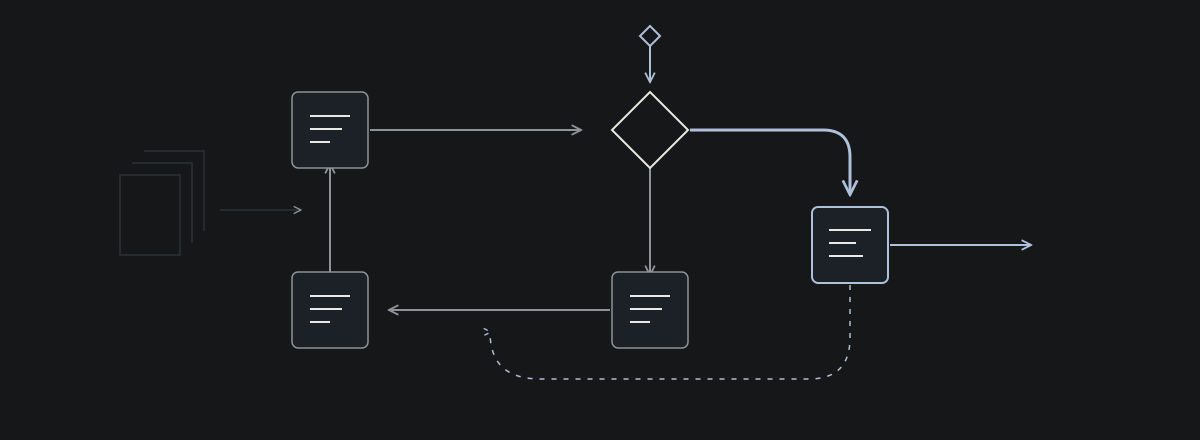
Schematic · not measured data Experience becomes useful when it can change a decision—and change it again.
Sources in this version
- Generative AI at Work ↗Published original · Abstract; Sections I and VPublished 4 February 2025 · recorded in Atlas 28 October 2026
- The Cybernetic Teammate: A Field Experiment on Generative AI and Teamwork ↗Published original · Methods; Table 2; sample footnotesPublished 12 June 2026 · recorded in Atlas 30 October 2026
- Building Customer Support AI Agents at 100M-User Scale: An Evaluation-Driven Framework ↗arXiv:2606.08867v1; KDD 2026 paper · Sections 4.4 and 6.3–6.4Published 7 June 2026 · recorded in Atlas 30 October 2026
- Democratizing online controlled experiments at Booking.com ↗arXiv:1710.08217v1 · Central repository of successes and failuresPublished 23 October 2017 · recorded in Atlas 30 October 2026
- Performative Prediction ↗Published original · Abstract and formal frameworkPublished 2020 · recorded in Atlas 30 October 2026
- Exploration and Exploitation in Organizational Learning ↗Published original · Mutual learning model and discussionPublished 1 February 1991 · recorded in Atlas 30 October 2026
- Formal and Real Authority in Organizations ↗Published original · Abstract and introductionPublished February 1997 · recorded in Atlas 30 October 2026
- Do Management Interventions Last? Evidence from India ↗Published original · Published abstractPublished April 2020 · recorded in Atlas 30 October 2026
- The Nature of the Firm ↗Published original · Sections I–IIPublished November 1937 · recorded in Atlas 30 October 2026
- Observe