A finished answer and a capable person are different outcomes.
AI can help someone produce an analysis they could not yet produce alone. The practical question is what happens next: can they explain it, challenge it and adapt the reasoning when the situation changes?
Which part of the work are you outsourcing?
Cognitive offloading means moving part of a mental task into a tool or the environment. A spreadsheet can spare you arithmetic while leaving you responsible for choosing the comparison. A conversational assistant can also choose the comparison, interpret it and write the conclusion. The useful question is which of those operations you still need to understand.
Consider an invented retention report. New customers retain at 40%, returning customers at 80%. With equal numbers of each, overall retention is 60%. If new customers become three quarters of the population, it falls to 50% even though neither group’s retention changes. The arithmetic is simple. The judgement is noticing that a changing customer mix could explain the headline.
An assistant might produce that explanation immediately. A person might verify every number and still miss the opportunity to practise deciding which groups to compare. Conversely, asking the assistant to test your proposed explanation can expose a mistake and create useful feedback. The mechanism depends on what you do with the assistance, not on whether you typed the final sentence.
The two paths above illustrate that distinction. They are choices about the work, not a validated recipe for making people learn.
A good answer passes only one of four checks.
“Better with AI” can describe a stronger person–tool system. That is valuable even if the person acquires no new knowledge. But it cannot, by itself, tell a manager whether a team is building expertise. Separate the evidence you would need for each claim.
Performance
- What to observe
- The assisted work meets the brief.
- What it does not establish
- The person understands how it was produced.
Understanding
- What to observe
- The person explains a decision and detects a planted error.
- What it does not establish
- That the understanding persists.
Retention
- What to observe
- Relevant knowledge remains at a later check without the same help.
- What it does not establish
- That it works on a different problem.
Transfer
- What to observe
- The person adapts the reasoning when a relevant condition changes.
- What it does not establish
- Expertise across the whole profession.
Atlas measurement framework. These checks serve different purposes; they are not a universal assessment scale.
Workers can gain capability without acquiring the underlying skill.
A study published in Nature Human Behaviour on 26 October 2026 examined 487 BCG consultants. Access and training in ChatGPT improved performance across three kinds of unfamiliar data-science tasks. Yet the researchers found no unaided knowledge advantage in the subsequent technical questions. The experiment ran in March–April 2024; a new publication date does not mean the latest models were tested. BCG supported the research, and BCG and OpenAI employees were among the authors.
Anthropic-affiliated researchers Shen and Tamkin found a sharper contrast in a randomized study of 52 people learning a Python library. The AI group performed worse on the immediate quiz, while the average speed gain was not statistically significant. Exploratory observations suggested that some participants used assistance to engage with concepts while others delegated the work. Those patterns were not randomized, so they cannot establish which habit caused better learning.
These findings distinguish a capability available through a tool from knowledge acquired through practice. They do not demonstrate that experienced workers lost skills they previously possessed. Failure to acquire a new skill, temporary dependence and erosion of an existing skill are different claims.
What changes when the help is removed?
Bastani and colleagues compared textbook practice with two GPT-4 tutors. Base could supply answers; Tutor combined hint-oriented instructions with teacher-provided solutions and guidance. Both raised practice scores. On the subsequent unaided exam, Base performed worse than control; Tutor showed no statistically detectable difference. Because the tutor changed several features together, this does not isolate the effect of hints alone.
Better practice scores did not guarantee better unaided scores.
One Turkish high school · autumn 2023 · four sessions. Practice and exam are different assessments.
Score difference from the control group · percentage points. Zero = no estimated difference.
- GPT Base · practice13.7; Approx. 95% CI 7.6 to 19.8
- GPT Tutor · practice36.1; Approx. 95% CI 29.8 to 42.4
- GPT Base · unaided exam-5.4; Approx. 95% CI -9.7 to -1.1
- GPT Tutor · unaided exam-0.4; Approx. 95% CI -2.9 to 2.1
Tutor’s unaided estimate is uncertain, not proven equal to control. These are short-term outcomes.
View data table & method
Table 1: coefficients × 100; approximate intervals = (coefficient ± 1.96 × classroom-clustered robust SE) × 100. Atlas calculation from rounded published inputs. 2,848 student-session observations per model; not 2,848 different students. Control means: practice 0.284, exam 0.321.
| Condition | Estimate | Approx. 95% CI |
|---|---|---|
| GPT Base · practice | 13.7 | 7.6–19.8 |
| GPT Tutor · practice | 36.1 | 29.8–42.4 |
| GPT Base · unaided exam | -5.4 | -9.7–-1.1 |
| GPT Tutor · unaided exam | -0.4 | -2.9–2.1 |
AI can also make useful practice easier to get.
In a study of 5,172 customer-support workers, mainly based in the Philippines, AI access raised resolved issues per hour by 15% on average. More relevant here, previously exposed workers still handled chats faster during outages. That is evidence consistent with learning from repeated suggestions. The outage analysis was noisy, could reflect a different mix of chats, and measured duration rather than successful resolution. It is a promising workplace counterexample, not a clean randomized test of retained skill.
A different intervention produced a clearer educational benefit. Kestin and colleagues tested a purpose-built AI tutor with 194 Harvard physics students across two lessons. Immediate post-test performance was better than after active classroom learning. The tutor incorporated instructional design and feedback; the result does not establish long-term retention or that ordinary chat use has the same effect.
The comparison suggests a useful hypothesis: assistance can remove a productive struggle, or help a person work through it with better feedback. A wrong first attempt is not inherently valuable. Its value depends on whether the learner can recognise the error, understand the correction and use it later.
Critical thinking can move to a different part of the job.
A CHI 2025 survey by Carnegie Mellon and Microsoft Research researchers collected 936 work examples from 319 AI users. Greater confidence in AI was associated with less reported critical-thinking effort; respondents also described work shifting toward verification, integration and oversight. These were self-reports, not measurements showing that people had become less capable.
That distinction matters. Letting software perform a routine calculation may free attention for a better question. Learning to choose tools, test outputs and combine evidence can itself be expertise. An unaided test is useful when it measures knowledge you need for those responsibilities; reproducing every automated step from memory is not automatically the right goal.
The difficult case is oversight without understanding. If someone can only approve an answer because it sounds plausible, moving them from producer to reviewer has not established that they can detect the failure they now own.
What else could explain the difference?
These studies differ in participants, tools, tasks, practice duration and assessments. A novice learning an unfamiliar library, a student reviewing mathematics and an experienced support worker handling recurring questions do not receive the same intervention. Their results should not be averaged into a single “AI learning effect”.
Output quality, time saved and understanding may also move independently. An immediate quiz can miss delayed learning, while a faster support conversation may reflect task mix rather than knowledge. To distinguish these possibilities, research needs appropriate comparison groups, delayed checks and genuinely new tasks—not only better scores on the assisted assignment.
Protect the judgement you will need when the answer is wrong.
For a person using AI, start with the decision you expect to remain responsible for. In the retention example, that might be choosing a fair comparison, recognising an alternative explanation and identifying missing evidence. Let the tool help with work that does not need to become your skill; deliberately practise the decisions that do.
For a team, keep delivery and development visible separately. Review whether the output is usable, then occasionally ask someone to explain an unfamiliar result, diagnose a plausible error or adapt the reasoning to a changed case. A prompt asking “do you understand?” measures something much weaker.
These are recommendations drawn from the evidence, not an Atlas-tested training programme. The next useful test would follow real people over time and compare equivalent work, understanding and transfer. Running the exercise with AI agents would answer a different question.
What supports the answer?
Reported finding: Assisted success does not establish acquired knowledge
Reported findingThe consultant experiment found higher assisted performance without a demonstrated unaided knowledge advantage.
Scope and conditions: Specific data-science tasks; short post-test, selective participation.
Vendor claim · origin, not a quality ratingSource passage · 2026Assisted task results and subsequent unaided knowledge questions are separate outcomes.
Abstract; Supplementary Table 7; reporting summary p. 2 About the source and its versionReported finding: A completed coding task can conceal a learning gap
Reported findingThe AI group scored lower on an immediate quiz.
Scope and conditions: 52 participants learning an unfamiliar library; preprint. Usage patterns were not randomized.
Vendor claim · origin, not a quality ratingSource passage · 2026Main experiment and exploratory interaction analysis must not be conflated.
Sections 5.2.1–5.2.2 and 6; Figure 6 About the source and its versionReported finding: The learning outcome depends on the intervention
Reported findingBoth tutoring conditions improved practice; the Base condition reduced subsequent unaided scores.
Scope and conditions: One school; short interval; Tutor’s near-zero estimate is not proof of equivalence.
Independent evidence · origin, not a quality ratingSource passage · 2025Four coefficient/standard-error pairs preserved in chart-data-v1.json.
Table 1; Results; Experimental Design About the source and its versionReported finding: There is evidence consistent with learning at work
Reported findingPreviously AI-exposed support workers handled chats faster during outages.
Scope and conditions: Observational outage analysis, noisy estimates, no chat-level resolution outcome.
Independent evidence · origin, not a quality ratingSource passage · 2025Outage outcome is chat duration. Resolution was unavailable at that grain; outages are rare and estimates noisy.
Abstract; Section VI.B, Figure VII About the source and its versionReported finding: Structured tutoring can improve assessed learning
Reported findingA designed AI tutor improved immediate physics post-test performance.
Scope and conditions: Harvard students; two lessons, not a universal tutoring effect.
Independent evidence · origin, not a quality ratingSource passage · 2025Immediate post-lesson performance in a deliberately designed tutor, not long-term occupational expertise.
Results and Discussion About the source and its versionReported finding: Critical-thinking effort may shift rather than disappear
Reported findingSurvey respondents described verification, integration and oversight.
Scope and conditions: Self-report associations, not measured cognitive decline.
Vendor claim · origin, not a quality ratingSource passage · 2025Associations and participants’ accounts do not establish loss of ability.
Abstract; Methods; Sections 4 and 7 About the source and its versionAuthor hypothesis · not established: Choose the reasoning you need to retain
Author hypothesis · not establishedAtlas recommends separating delivery checks from checks of understanding, retention and transfer.
Scope and conditions: Editorial synthesis and illustrated example; not an Atlas-tested training method.
Vendor claim · origin, not a quality ratingSource passage · 2026Assisted task results and subsequent unaided knowledge questions are separate outcomes.
Abstract; Supplementary Table 7; reporting summary p. 2 About the source and its versionVendor claim · origin, not a quality ratingSource passage · 2026Main experiment and exploratory interaction analysis must not be conflated.
Sections 5.2.1–5.2.2 and 6; Figure 6 About the source and its versionIndependent evidence · origin, not a quality ratingSource passage · 2025Four coefficient/standard-error pairs preserved in chart-data-v1.json.
Table 1; Results; Experimental Design About the source and its versionIndependent evidence · origin, not a quality ratingSource passage · 2025Outage outcome is chat duration. Resolution was unavailable at that grain; outages are rare and estimates noisy.
Abstract; Section VI.B, Figure VII About the source and its versionIndependent evidence · origin, not a quality ratingSource passage · 2025Immediate post-lesson performance in a deliberately designed tutor, not long-term occupational expertise.
Results and Discussion About the source and its versionVendor claim · origin, not a quality ratingSource passage · 2025Associations and participants’ accounts do not establish loss of ability.
Abstract; Methods; Sections 4 and 7 About the source and its version
Where this explanation stops.
- Most assessments here are short-term. Reduced acquisition of a new skill is not demonstrated erosion of an existing one.
- Specific workers, schools and tool designs do not represent all professions, languages or current AI products.
- The example and proposed checks are editorial illustrations. Atlas has not run a human learning experiment or validated a training method.
What to take with you
Choose the judgement you need to retain, give it opportunities for practice and check it separately from the deliverable.
Follow the answer back to its sources.
Browse 6 source records
Generative AI and the temporary upskilling of knowledge workers
Emma Wiles, Lisa Krayer, Mohamed Abbadi, Urvi Awasthi, Ryan Kennedy, Pamela Mishkin, Daniel Sack and Francois Candelon
Nature Human Behaviour · Published original
Published in October 2026; data collected March–April 2024. Public abstract, disclosures, Supplementary Table 7 and reporting summary consulted; subscription full text unavailable. BCG staff and an OpenAI employee are co-authors; Wiles received BCG consulting fees. Selected volunteers, not a representative workforce.
DOI: 10.1038/s41562-026-02566-6
Source passages, license and conditions ↗
How AI Impacts Skill Formation
Judy Hanwen Shen and Alex Tamkin
arXiv · Anthropic-affiliated authors · arXiv:2601.20245v2
arXiv v2 dated 1 February 2026. Main study n=52; sidebar assistance, not an autonomous coding agent. Immediate assessment; country distribution not established in consulted text. No long-term deskilling claim.
Source passages, license and conditions ↗
Generative AI without guardrails can harm learning: Evidence from high school mathematics
Hamsa Bastani, Osbert Bastani, Alp Sungu, Haosen Ge, Özge Kabakcı and Rei Mariman
PNAS · Published original
Autumn 2023–24, one Turkish high school. Table 1 inspected. Correction dated 20 August 2025 changes Osbert Bastani’s affiliation, not the numerical results: https://doi.org/10.1073/pnas.2518204122.
DOI: 10.1073/pnas.2422633122
Source passages, license and conditions ↗
Generative AI at Work
Erik Brynjolfsson, Danielle Li and Lindsey Raymond
The Quarterly Journal of Economics · Published original
Published 2025; historical GPT-3-based workplace deployment, including 2020 outages. Mainly Philippines-based support workers serving US customers. Section VI.B and Figure VII consulted.
DOI: 10.1093/qje/qjae044
Source passages, license and conditions ↗
AI tutoring outperforms in-class active learning: an RCT introducing a novel research-based design in an authentic educational setting
Greg Kestin, Kelly Miller, Anna Klales, Timothy Milbourne and Gregorio Ponti
Scientific Reports · Published original
194 Harvard physics students; two lessons and immediate post-tests. Publication is not a test of present-day general-purpose assistants. Indexed publisher original consulted; no source figure reproduced.
DOI: 10.1038/s41598-025-97652-6
Source passages, license and conditions ↗
The Impact of Generative AI on Critical Thinking: Self-Reported Reductions in Cognitive Effort and Confidence Effects From a Survey of Knowledge Workers
Hao-Ping Lee, Advait Sarkar, Lev Tankelevitch, Ian Drosos, Sean Rintel, Richard Banks and Nicholas Wilson
CHI 2025 · Carnegie Mellon and Microsoft Research · Published original
Survey of weekly GenAI users, not a longitudinal or randomized test of skill. Publisher and author-hosted original consulted. Microsoft-affiliated research is identified as provider-origin research.
DOI: 10.1145/3706598.3713778
Source passages, license and conditions ↗
How this version was checked
AI-reviewed by a separate editorial agent · 28 October 2026. The approval applies to revision 1, its text, visuals and source references.
Better output can hide what remains unknown about the person’s capability.
AI-reviewed by a separate editorial agent · Ask the editor
What changed, and why.
Changes across Atlas →This history comes from saved content versions. A new revision can be an editorial change; it does not by itself mean that the underlying facts changed.
First recorded version · revision 1
First dedicated answer on human expertise: distinguish assisted performance, understanding, retention and transfer, using workplace and educational studies and an illustrated reasoning task.
No earlier reviewed assessment is available to compare. No change in the underlying facts is being claimed.
Available version records (1)
Revision 1 · First recorded version · reviewed
First dedicated answer on human expertise: distinguish assisted performance, understanding, retention and transfer, using workplace and educational studies and an illustrated reasoning task.
Answer in this version
Identify the decisions you must understand well enough to challenge, then check those abilities on a later unfamiliar task.
What remained unresolved
Longer studies with real workers, delayed assessments, changed tasks and comparable delivery quality.
Takeaway and scope
AI can improve the work without improving the worker’s underlying skill. It can also support learning. The difference depends on the assistance and the reasoning the person still does; better output alone cannot tell you which happened.
Workplace studies and education experiments measure different outcomes. Evidence of long-term professional deskilling remains limited.
Assisted success does not establish acquired knowledge
The consultant experiment found higher assisted performance without a demonstrated unaided knowledge advantage.
Specific data-science tasks; short post-test, selective participation.
A completed coding task can conceal a learning gap
The AI group scored lower on an immediate quiz.
52 participants learning an unfamiliar library; preprint. Usage patterns were not randomized.
The learning outcome depends on the intervention
Both tutoring conditions improved practice; the Base condition reduced subsequent unaided scores.
One school; short interval; Tutor’s near-zero estimate is not proof of equivalence.
There is evidence consistent with learning at work
Previously AI-exposed support workers handled chats faster during outages.
Observational outage analysis, noisy estimates, no chat-level resolution outcome.
Structured tutoring can improve assessed learning
A designed AI tutor improved immediate physics post-test performance.
Harvard students; two lessons, not a universal tutoring effect.
Critical-thinking effort may shift rather than disappear
Survey respondents described verification, integration and oversight.
Self-report associations, not measured cognitive decline.
Choose the reasoning you need to retain
Atlas recommends separating delivery checks from checks of understanding, retention and transfer.
Editorial synthesis and illustrated example; not an Atlas-tested training method.
Explanation in this version
Which part of the work are you outsourcing?
Cognitive offloading means moving part of a mental task into a tool or the environment. A spreadsheet can spare you arithmetic while leaving you responsible for choosing the comparison. A conversational assistant can also choose the comparison, interpret it and write the conclusion. The useful question is which of those operations you still need to understand.
Consider an invented retention report. New customers retain at 40%, returning customers at 80%. With equal numbers of each, overall retention is 60%. If new customers become three quarters of the population, it falls to 50% even though neither group’s retention changes. The arithmetic is simple. The judgement is noticing that a changing customer mix could explain the headline.
An assistant might produce that explanation immediately. A person might verify every number and still miss the opportunity to practise deciding which groups to compare. Conversely, asking the assistant to test your proposed explanation can expose a mistake and create useful feedback. The mechanism depends on what you do with the assistance, not on whether you typed the final sentence.
The two paths above illustrate that distinction. They are choices about the work, not a validated recipe for making people learn.
Illustrated mechanism · not an experiment The same deliverable can contain different amounts of your reasoning.
An analyst must explain a fall in customer retention. Both routes could produce a correct note. Change who forms and checks the explanation.
Frame the question
- You
- Provide the data and ask why retention fell.
- AI
- Choose comparisons and propose explanations.
Produce the analysis
- You
- Read the proposed explanation.
- AI
- Calculate, interpret and draft the note.
Check the answer
- You
- Check its figures and sources before using it.
- AI
- Revise the draft when challenged.
- The deliverable
- A checked note may be ready to use.
- What you practise
- Reading and checking; you may never have chosen the comparison or formed an explanation yourself.
Still to check Can you explain the result and identify which new evidence would overturn it?
Atlas-authored illustration. No people or models were tested; neither route guarantees learning or correctness.
Read both paths
Ask for the explanation
Frame the question
- You
- Provide the data and ask why retention fell.
- AI
- Choose comparisons and propose explanations.
Produce the analysis
- You
- Read the proposed explanation.
- AI
- Calculate, interpret and draft the note.
Check the answer
- You
- Check its figures and sources before using it.
- AI
- Revise the draft when challenged.
- The deliverable
- A checked note may be ready to use.
- What you practise
- Reading and checking; you may never have chosen the comparison or formed an explanation yourself.
Still to check Can you explain the result and identify which new evidence would overturn it?
Make and revise a judgement
Form a prediction
- You
- Write a tentative explanation and a comparison that could disprove it.
- AI
- Help locate the relevant fields and define the calculation.
Test the explanation
- You
- Interpret the comparison; explain why your first view holds or fails.
- AI
- Check arithmetic and challenge a missing assumption.
Try a changed case
- You
- Predict the outcome with different customer proportions, then check it.
- AI
- Provide feedback and help prepare the final note.
- The deliverable
- The same checked note is still the goal.
- What you practise
- Choosing a test, interpreting evidence and revising an explanation.
Still to check A later unfamiliar case is needed to find out what you retained and can transfer.
A good answer passes only one of four checks.
“Better with AI” can describe a stronger person–tool system. That is valuable even if the person acquires no new knowledge. But it cannot, by itself, tell a manager whether a team is building expertise. Separate the evidence you would need for each claim.
Four outcomes, four different checks Performance
- What to observe
- The assisted work meets the brief.
- What it does not establish
- The person understands how it was produced.
Understanding
- What to observe
- The person explains a decision and detects a planted error.
- What it does not establish
- That the understanding persists.
Retention
- What to observe
- Relevant knowledge remains at a later check without the same help.
- What it does not establish
- That it works on a different problem.
Transfer
- What to observe
- The person adapts the reasoning when a relevant condition changes.
- What it does not establish
- Expertise across the whole profession.
Atlas measurement framework. These checks serve different purposes; they are not a universal assessment scale.
Workers can gain capability without acquiring the underlying skill.
A study published in Nature Human Behaviour on 26 October 2026 examined 487 BCG consultants. Access and training in ChatGPT improved performance across three kinds of unfamiliar data-science tasks. Yet the researchers found no unaided knowledge advantage in the subsequent technical questions. The experiment ran in March–April 2024; a new publication date does not mean the latest models were tested. BCG supported the research, and BCG and OpenAI employees were among the authors.
Anthropic-affiliated researchers Shen and Tamkin found a sharper contrast in a randomized study of 52 people learning a Python library. The AI group performed worse on the immediate quiz, while the average speed gain was not statistically significant. Exploratory observations suggested that some participants used assistance to engage with concepts while others delegated the work. Those patterns were not randomized, so they cannot establish which habit caused better learning.
These findings distinguish a capability available through a tool from knowledge acquired through practice. They do not demonstrate that experienced workers lost skills they previously possessed. Failure to acquire a new skill, temporary dependence and erosion of an existing skill are different claims.
What changes when the help is removed?
Bastani and colleagues compared textbook practice with two GPT-4 tutors. Base could supply answers; Tutor combined hint-oriented instructions with teacher-provided solutions and guidance. Both raised practice scores. On the subsequent unaided exam, Base performed worse than control; Tutor showed no statistically detectable difference. Because the tutor changed several features together, this does not isolate the effect of hints alone.
Independent study · Bastani et al. · PNAS 2025 Better practice scores did not guarantee better unaided scores.
One Turkish high school · autumn 2023 · four sessions. Practice and exam are different assessments.
Score difference from the control group · percentage points. Zero = no estimated difference.
- GPT Base · practice13.7; Approx. 95% CI 7.6 to 19.8
- GPT Tutor · practice36.1; Approx. 95% CI 29.8 to 42.4
- GPT Base · unaided exam-5.4; Approx. 95% CI -9.7 to -1.1
- GPT Tutor · unaided exam-0.4; Approx. 95% CI -2.9 to 2.1
Tutor’s unaided estimate is uncertain, not proven equal to control. These are short-term outcomes.
View data table & method
Table 1: coefficients × 100; approximate intervals = (coefficient ± 1.96 × classroom-clustered robust SE) × 100. Atlas calculation from rounded published inputs. 2,848 student-session observations per model; not 2,848 different students. Control means: practice 0.284, exam 0.321.
Score difference from the control group · percentage points. Zero = no estimated difference. Condition Estimate Approx. 95% CI GPT Base · practice 13.7 7.6–19.8 GPT Tutor · practice 36.1 29.8–42.4 GPT Base · unaided exam -5.4 -9.7–-1.1 GPT Tutor · unaided exam -0.4 -2.9–2.1 AI can also make useful practice easier to get.
In a study of 5,172 customer-support workers, mainly based in the Philippines, AI access raised resolved issues per hour by 15% on average. More relevant here, previously exposed workers still handled chats faster during outages. That is evidence consistent with learning from repeated suggestions. The outage analysis was noisy, could reflect a different mix of chats, and measured duration rather than successful resolution. It is a promising workplace counterexample, not a clean randomized test of retained skill.
A different intervention produced a clearer educational benefit. Kestin and colleagues tested a purpose-built AI tutor with 194 Harvard physics students across two lessons. Immediate post-test performance was better than after active classroom learning. The tutor incorporated instructional design and feedback; the result does not establish long-term retention or that ordinary chat use has the same effect.
The comparison suggests a useful hypothesis: assistance can remove a productive struggle, or help a person work through it with better feedback. A wrong first attempt is not inherently valuable. Its value depends on whether the learner can recognise the error, understand the correction and use it later.
Critical thinking can move to a different part of the job.
A CHI 2025 survey by Carnegie Mellon and Microsoft Research researchers collected 936 work examples from 319 AI users. Greater confidence in AI was associated with less reported critical-thinking effort; respondents also described work shifting toward verification, integration and oversight. These were self-reports, not measurements showing that people had become less capable.
That distinction matters. Letting software perform a routine calculation may free attention for a better question. Learning to choose tools, test outputs and combine evidence can itself be expertise. An unaided test is useful when it measures knowledge you need for those responsibilities; reproducing every automated step from memory is not automatically the right goal.
The difficult case is oversight without understanding. If someone can only approve an answer because it sounds plausible, moving them from producer to reviewer has not established that they can detect the failure they now own.
What else could explain the difference?
These studies differ in participants, tools, tasks, practice duration and assessments. A novice learning an unfamiliar library, a student reviewing mathematics and an experienced support worker handling recurring questions do not receive the same intervention. Their results should not be averaged into a single “AI learning effect”.
Output quality, time saved and understanding may also move independently. An immediate quiz can miss delayed learning, while a faster support conversation may reflect task mix rather than knowledge. To distinguish these possibilities, research needs appropriate comparison groups, delayed checks and genuinely new tasks—not only better scores on the assisted assignment.
Protect the judgement you will need when the answer is wrong.
For a person using AI, start with the decision you expect to remain responsible for. In the retention example, that might be choosing a fair comparison, recognising an alternative explanation and identifying missing evidence. Let the tool help with work that does not need to become your skill; deliberately practise the decisions that do.
For a team, keep delivery and development visible separately. Review whether the output is usable, then occasionally ask someone to explain an unfamiliar result, diagnose a plausible error or adapt the reasoning to a changed case. A prompt asking “do you understand?” measures something much weaker.
These are recommendations drawn from the evidence, not an Atlas-tested training programme. The next useful test would follow real people over time and compare equivalent work, understanding and transfer. Running the exercise with AI agents would answer a different question.
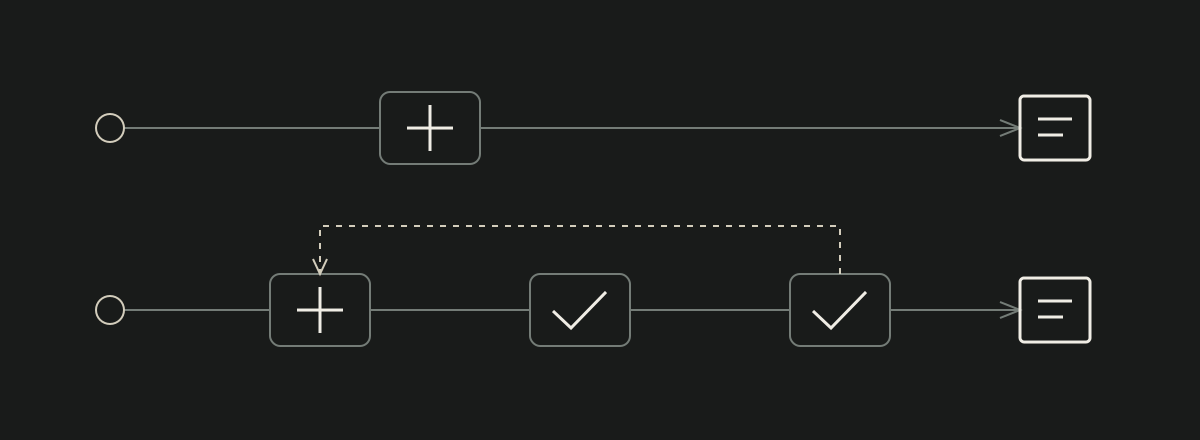
Schematic · not measured data A similar deliverable can come from different opportunities to practise. Conceptual illustration, not study data.
Sources in this version
- Generative AI and the temporary upskilling of knowledge workers ↗Published original · Abstract; Supplementary Table 7; reporting summary p. 2Published 26 October 2026 · recorded in Atlas 28 October 2026
- How AI Impacts Skill Formation ↗arXiv:2601.20245v2 · Sections 5.2.1–5.2.2 and 6; Figure 6Published 1 February 2026 · recorded in Atlas 28 October 2026
- Generative AI without guardrails can harm learning: Evidence from high school mathematics ↗Published original · Table 1; Results; Experimental DesignPublished 25 June 2025 · recorded in Atlas 28 October 2026
- Generative AI at Work ↗Published original · Abstract; Section VI.B, Figure VIIPublished 4 February 2025 · recorded in Atlas 28 October 2026
- AI tutoring outperforms in-class active learning: an RCT introducing a novel research-based design in an authentic educational setting ↗Published original · Results and DiscussionPublished 3 June 2025 · recorded in Atlas 28 October 2026
- The Impact of Generative AI on Critical Thinking: Self-Reported Reductions in Cognitive Effort and Confidence Effects From a Survey of Knowledge Workers ↗Published original · Abstract; Methods; Sections 4 and 7Published 25 April 2025 · recorded in Atlas 28 October 2026